

Product Counting using Visual AI: Automating Production Counting in Manufacturing
Generate a quick summary


For manufacturers, production counts influence output reporting, packaging quantities, inventory movement, throughput measurement, shift performance, and production planning.
When recorded production does not match what physically moved through the line, teams need to understand where the difference occurred.
That becomes difficult when products overlap, stop and restart, change orientation, move at different speeds, or remain visible across multiple video frames.
Product Counting using Visual AI provides an independent way to verify physical product movement using cameras, Computer Vision, object tracking, and production-specific counting rules.
The objective is to establish a production count that reflects what actually moved through the process.
When Production Records and Physical Output Do Not Match
Manufacturing operations generate large volumes of production data.
PLCs record machine cycles. MES platforms capture production activity. ERP systems manage production orders and inventory transactions. Operators maintain shift-level records.
But these systems do not always confirm how many physical products actually passed through a production point.
A machine cycle may not result in an acceptable unit. Products can be removed from the line. Sensors can trigger without identifying what passed. Manual records may require reconciliation later.
Visual counting provides another source of production evidence by measuring product movement directly.
The business question is simple.
“Does reported production match actual production?”
Why Product Counting Is Difficult in Real Production
Counting is straightforward when products move one at a time under consistent conditions.
Manufacturing lines introduce variability. Products can overlap, bunch together, block one another, change orientation, vary by SKU or packaging, and re-enter a monitored area. Line speed, lighting, reflections, and spacing can also change during production.
Industrial object counting research identifies occlusion, object overlap, scale variation, and changing operating conditions among the factors that affect industrial counting performance.
For manufacturers, counting should be validated against actual production conditions rather than selected demonstration footage.
A Production Count Requires Detection, Tracking, and Rules
Computer Vision can identify a product in a camera frame. That alone does not create a production count.
The same product may appear across multiple video frames as it moves through the camera view. Without tracking, one physical product could generate multiple detections.
A practical workflow is
Camera → Product Detection → Object Tracking → Counting Rule → Production Event

Tracking maintains the identity of the product as it moves.
A production-specific rule then determines when the product should be counted. The event may be triggered when the product crosses a virtual line, exits a production station, enters packaging, or reaches an end-of-line checkpoint.
Automatic Product Counting with Computer Vision therefore records the movement event rather than every detection.
Detection + Tracking + Counting Logic = Production Counting

Counting Accuracy Is a System-Level Measure
Manufacturers evaluating Computer Vision Based Automatic Counting should look beyond a single model accuracy percentage.
Counting performance depends on camera position, lighting, line speed, product spacing, packaging variation, image quality, tracking performance, processing architecture, and counting-rule configuration.
These factors determine whether a system performs consistently under the conditions the plant experiences every day.
At enterprise scale, product counting can form part of a broader Enterprise Computer Vision architecture connecting cameras, AI models, edge infrastructure, enterprise systems, and operational workflows.

NIST’s 2026 smart manufacturing roadmap also identifies sensing, industrial data management, system integration, and trustworthy AI operation as important considerations for manufacturing AI deployment.
Where Product Counting Creates Business Value
The business case is strongest where inaccurate counts create additional operational work.
At end-of-line production, AI Product Counting can provide an independent measure of completed output.
Between production stages, visual counts can compare quantities entering and leaving a process.
Before packaging, manufacturers can compare produced quantities against packed quantities.
At transfer or palletization points, counting can provide an additional check before products move into warehouse inventory.
The same data can support
- Actual production output
- Units per minute or hour
- Output by shift
- Planned versus actual production
- Throughput variation
- Product movement by SKU
- Packaging or transfer quantities
This gives operations teams another way to identify where production begins to diverge from plan.
The same infrastructure can also support visual quality inspection in manufacturing, creating a broader view of product movement and quality across production.
AI Visual Counting in Manufacturing can provide continuous visibility into product movement across shifts, SKUs, production stages, and transfer points.
From Product Counts to Production Intelligence
A count shows what moved through the line.
Its value increases when that information is connected with production context.
Visual counting data can be combined with MES, ERP, WMS, equipment information, production plans, and operational reporting.
Camera → Vision AI → Count Events → MES / ERP → Operations Dashboard
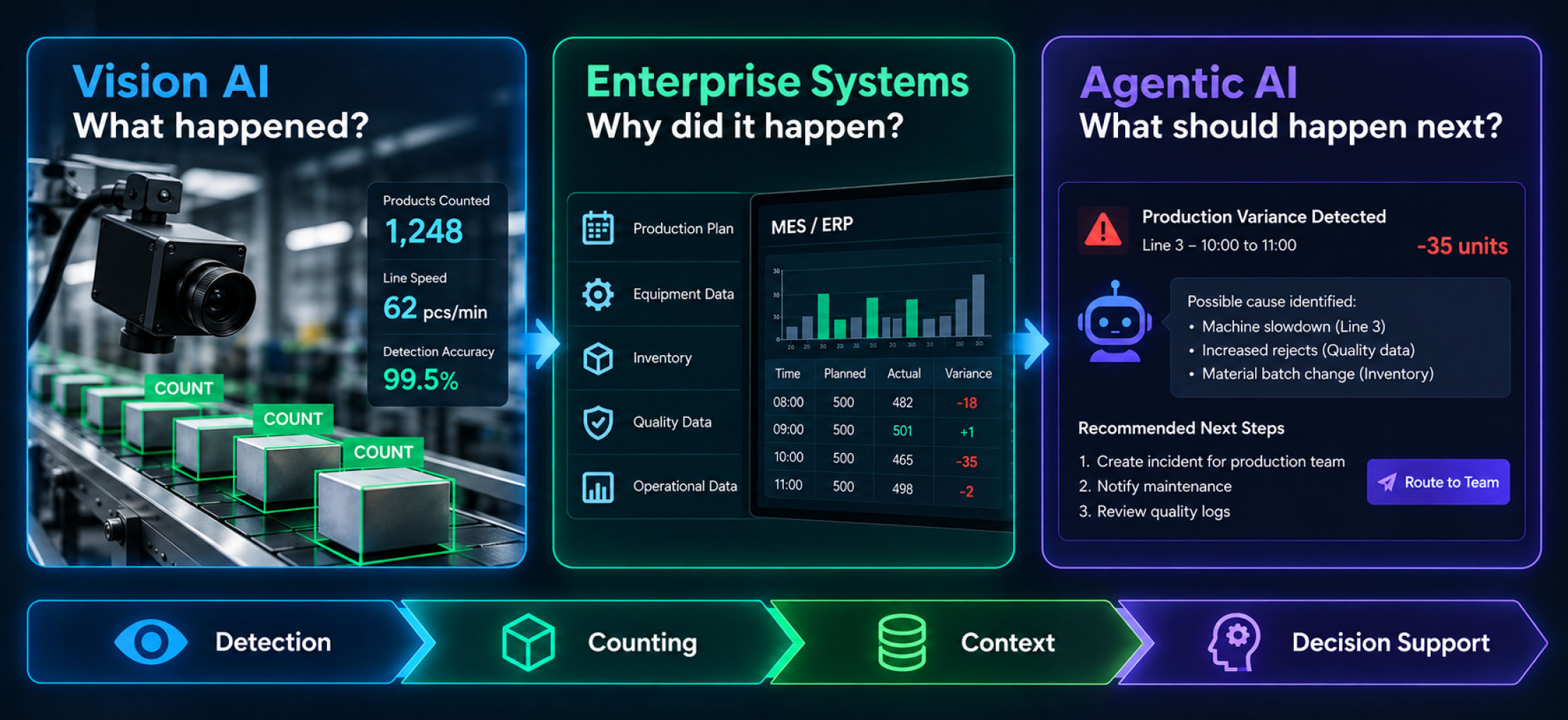
This makes it possible to compare physical output with production targets and investigate meaningful variance.
Agentic AI can support this process by bringing relevant operational information together, summarizing exceptions, and directing them to the appropriate team for review.
The role of the technology is clear.
Vision AI provides visual evidence. Enterprise systems provide operational context. Agentic AI supports faster review and response.
How ImageVision.ai Approaches Product Counting
At ImageVision.ai, Product Counting is treated as a production-data requirement rather than an object-detection exercise. The approach combines Vision AI, object tracking, and production-specific counting logic with the operating conditions of the line.
Product characteristics, line speed, camera placement, lighting, processing requirements, and counting rules are considered as part of the deployment. Where required, count events can be connected with MES, ERP, WMS, dashboards, and other operational systems.
The same Computer Vision applications infrastructure can support adjacent manufacturing requirements such as inspection, production monitoring, and operational intelligence.
The objective is to build a counting capability that can operate within the broader manufacturing environment rather than remain an isolated application.
What Manufacturers Should Validate Before Scaling
A successful pilot on one production line is only the first validation point.
Manufacturers should test different SKUs, production speeds, lighting conditions, temporary stoppages, product overlap, re-entry events, packaging variation, and operator interaction.
They should also establish how counting accuracy will be measured, how exceptions will be reviewed, how data will integrate with existing systems, and how performance will be monitored across facilities.
A counting system becomes valuable at enterprise scale when its performance can be replicated across lines, shifts, products, and plants.
Making Physical Production Visible Across Enterprise
At manufacturing scale, product counting ultimately comes down to whether physical production and enterprise records represent the same operational reality.
When visual count data is connected with production plans, MES, ERP, WMS, and operational reporting, counting becomes part of production control rather than a standalone automation function.
Contact us to evaluate how Visual AI can support accurate product counting and production visibility in your manufacturing environment.