

Advancing Public Safety Monitoring with Intelligent Video Analytics
Generate a quick summary


Public safety camera networks span roads, transportation systems, airports, ports, government facilities, public spaces, and critical infrastructure. As these environments expand, security and operations teams have to manage more video, review incidents across multiple locations, and retrieve relevant evidence without increasing manual monitoring at the same pace.
Intelligent Video Analytics with Vision AI analyzes live and recorded video for defined objects, activities, movements, and conditions. Traffic incidents, restricted-area activity, crowd congestion, unattended objects, visible weapons, fire, smoke, and other defined events can be associated with the relevant camera, location, timestamp, and supporting footage.
ImageVision.ai combines Enterprise Vision AI and Agentic AI across this operating environment. Enterprise Vision AI manages visual intelligence across cameras, locations, and use cases, while Agentic AI supports the context and workflows surrounding detected events.
Intelligent Video Analytics Across Public Safety Operations
Traditional surveillance infrastructure provides the video record, but large camera estates create a substantial monitoring and review workload.
An incident may appear briefly on one camera, move between locations, or become relevant only when combined with a specific operating rule.
AI video analytics reduces that search effort by bringing defined events to operator attention with the associated visual evidence.
A stopped vehicle can be identified on a controlled roadway. Crowd density can be monitored inside a transit hub. Movement within a restricted area can be presented for review. Fire, smoke, abandoned objects, or unusual activity can be detected within the camera view.
Human review remains part of the operating process. Video analytics narrows the amount of footage requiring continuous attention and gives teams a clearer starting point when an incident needs verification.
ImageVision.ai’s Vision AI in Security and Surveillance capabilities cover threat detection, weapon detection, posture and gesture detection, drone monitoring, and other security monitoring scenarios.
Applying Visual Intelligence to Real Operating Conditions
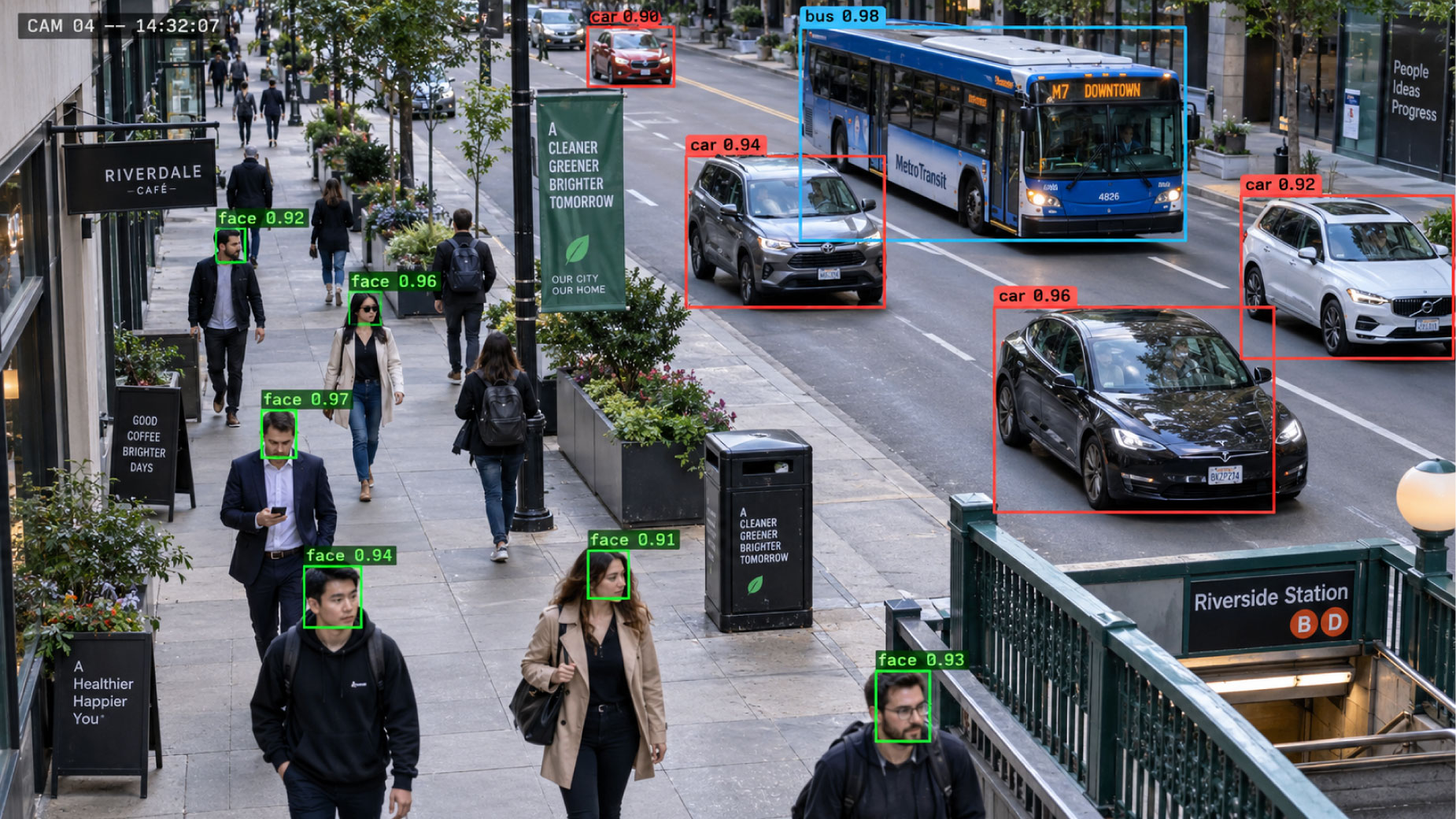
Public safety environments have different monitoring priorities, and analytics need to reflect those differences.
Transportation networks may require accident detection, wrong-way movement, traffic congestion, illegal parking, vehicle tracking, or license plate recognition. ImageVision.ai’s Computer Vision for Transportation portfolio includes accident detection, traffic counting, automated license plate recognition, overspeeding detection, vehicle tracking, and lane monitoring.
Airports, transit hubs, and public facilities may focus on crowd density, queue formation, unattended objects, or restricted-area activity. Ports, utilities, government facilities, and critical infrastructure may place greater emphasis on perimeter monitoring, controlled zones, remote locations, and activity outside approved operating conditions.
The operating context determines the significance of an event. A vehicle remaining stationary for a short period may be routine in one location and require immediate review inside a tunnel, secure gate, restricted lane, or perimeter area.
Effective surveillance video analytics therefore depends on event rules, camera context, and response requirements as much as the underlying detection model.
Managing Alert Volume and Incident Priority
Large-scale video analytics can generate significant alert volume. Treating every detection with the same priority can shift workload from camera feeds to alert queues.
Alert rules need to account for location, event duration, severity, operating hours, object behavior, and the response procedure associated with the site. Similar events may need to be grouped, while low-relevance detections may not need to reach an operator.
False and duplicate alerts also influence day-to-day performance. Repeated low-value notifications increase review effort and can reduce confidence in the system even when the model performs well during controlled testing.
Evaluation of Intelligent video analytics solutions should include alert relevance, duplicate behavior, event latency, and the information presented to the operator alongside model performance.
Enterprise Vision AI and Agentic AI Across the Incident Lifecycle
Enterprise Vision AI provides a common layer for managing visual events across multiple cameras, locations, and use cases.
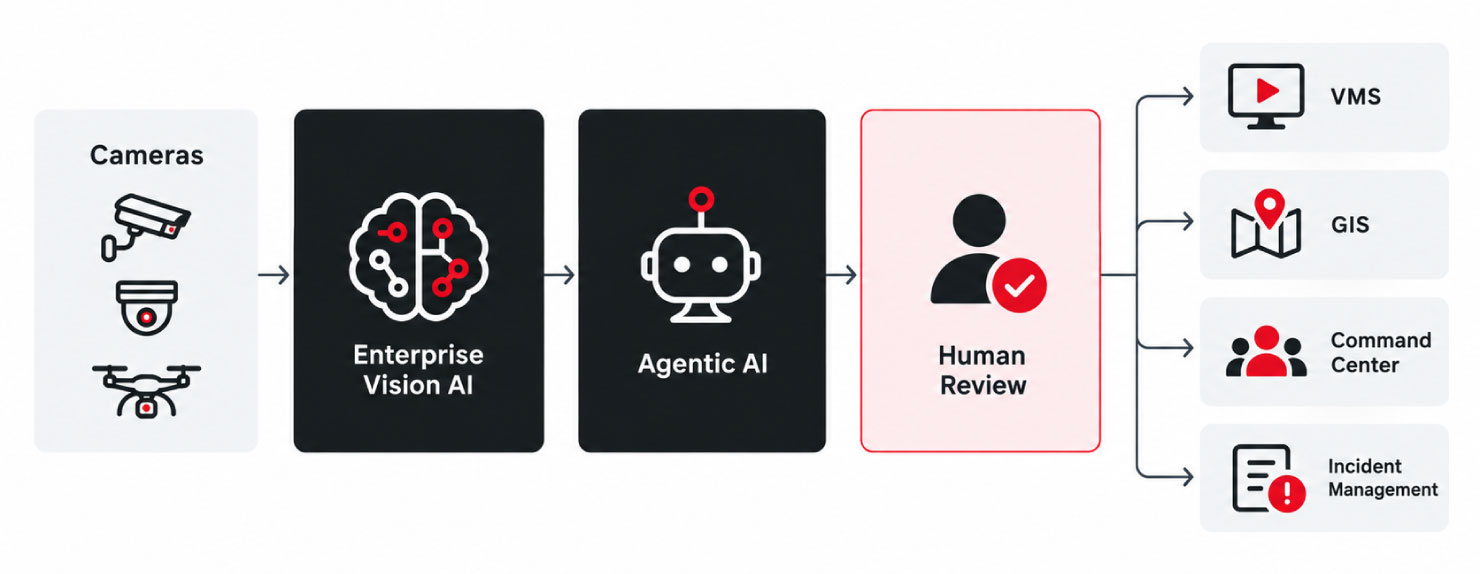
ImageVision.ai supports custom Vision AI applications, real-time video processing, event rules, system monitoring, APIs, model management, role-based access, audit trails, and integration with existing technology environments.
Its Enterprise Computer Vision Development Services also cover production deployment, integration, Edge AI, Cloud AI, Hybrid AI, monitoring, and model lifecycle requirements across enterprise environments.
Agentic AI extends the workflow after an event has been identified.
A public safety incident may involve a camera source, location, timestamp, related footage, previous alerts, site information, and an established escalation procedure. Gathering this information manually across separate systems can slow incident review when several events are being handled at the same time.
Agentic AI can organize available context, prepare incident summaries, support prioritization based on approved rules, and route information through defined workflows. Human personnel remain responsible for verification and decisions involving public safety, security, or enforcement.
Integrating Video Intelligence with Existing Public Safety Systems
Public safety technology environments typically include CCTV and IP cameras, video management systems, network video recorders, access-control platforms, command centers, GIS systems, traffic-management platforms, and incident-management applications.
Video analytics needs to operate within this infrastructure rather than become another isolated application.
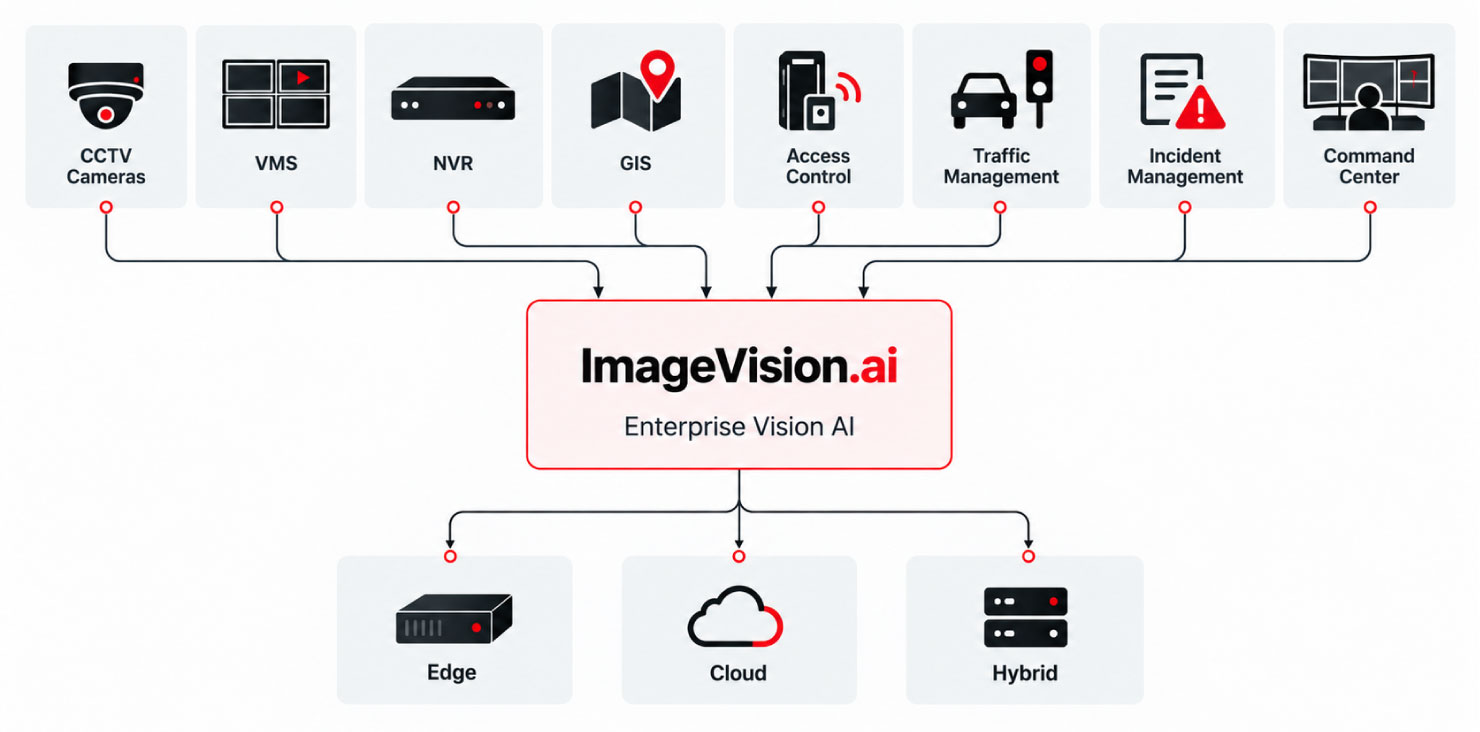
ImageVision.ai supports APIs, third-party integration, custom application development, video-stream processing, system monitoring, and scalable deployment as part of its Enterprise Vision AI approach.
Camera suitability also needs to be assessed for each use case. Field of view, resolution, frame rate, lighting, weather, object distance, occlusion, and stream availability all influence performance.
A camera installed for general surveillance may not provide the visual conditions required for detailed vehicle classification, crowd monitoring, or another specialized analytic. Infrastructure and camera assessment should therefore be part of deployment planning.
Deployment Architecture, Governance, and Production Readiness
Processing architecture should follow the requirements of the operating environment.
Edge processing can support applications where response time, bandwidth, connectivity, or local data control are important. On-premises environments may be appropriate where tighter infrastructure control is required. Cloud and hybrid architecture can support centralized management across distributed locations.
ImageVision.ai supports Edge AI, Cloud AI, and Hybrid AI deployment models, allowing infrastructure decisions to follow operational and security requirements.
Public safety deployments also need controls covering access, retention, auditability, model changes, alert review, and human verification. Role-based access, audit records, encryption, system monitoring, and defined approval procedures should form part of production planning.
ImageVision.ai’s ISO/IEC 27001:2022 certification adds an information-security credential relevant to enterprise and mission-critical deployments.
The NIST AI Risk Management Framework provides a useful reference for AI governance, accountability, risk management, and trustworthiness.
Production acceptance should extend beyond a single accuracy figure. Testing should cover expected scene conditions, alert quality, event latency, camera suitability, integration, system availability, auditability, and operator workflow.
Scaling Video Intelligence Across Public Safety Operations
Public safety programs may begin with traffic monitoring, perimeter security, crowd analytics, fire and smoke detection, intrusion monitoring, or another focused requirement.
Complexity increases when every additional use case introduces another application, dashboard, integration, infrastructure stack, and support process.
An Enterprise Vision AI approach provides a common environment across visual use cases while maintaining consistent integration, access controls, model management, monitoring, and governance.
ImageVision.ai brings these capabilities together across existing camera infrastructure with custom Vision AI applications, enterprise integration, system monitoring, and edge, cloud, and hybrid deployment. Agentic AI supports the incident context and workflow once visual events enter the operating process.
This provides a path to expand public safety analytics across locations without creating a separate technology stack around every new requirement.
Conclusion
Intelligent Video Analytics has a practical role in public safety when it reduces unnecessary video review, improves access to relevant incident information, and works within established operational processes.
ImageVision.ai brings Enterprise Vision AI and Agentic AI together with existing visual infrastructure, enterprise systems, governance controls, and flexible deployment models across security, transportation, and public safety environments.
Speak to our expert to assess how Intelligent Video Analytics, Enterprise Vision AI, and Agentic AI can support existing public safety infrastructure and operations.