

Vision AI vs Traditional Cameras: Why Passive Surveillance Is No Longer Enough
Generate a quick summary


Facilities across packaging, healthcare, transportation, and manufacturing have been using camera infrastructure for over two decades to improve operational visibility. Despite this investment, critical gaps remain. Incidents continue to occur in real time. Defects pass through production lines. Compliance violations are identified during audits rather than at the point of occurrence. The limitation is not coverage. It is capability.
Most camera systems capture and store video but do not interpret it in real time. This creates a gap between visibility and action, where risks are recorded but not prevented. This is where the distinction between Vision AI vs traditional cameras becomes operationally significant.
Vision AI applies Computer Vision models to analyze video feeds in real time, enabling real-time threat detection across safety, quality, and compliance cases.
The Cognitive Limits of Human Monitoring
The effectiveness of traditional surveillance systems depends on human operators monitoring video feeds in real time or reviewing footage after the fact. This creates a structural limitation that cannot be addressed through training or increased staffing.
- Operator Attention Declines Over Time: Human attention degrades during prolonged monitoring tasks, a phenomenon known as vigilance decrement. This is a well-established limitation in cognitive science and affects continuous surveillance performance. In practice, this reduces the ability to sustain consistent detection across extended monitoring periods.
- Detection Performance Is Constrained by Monitoring Complexity: CCTV monitoring requires operators to interpret dynamic scenes across multiple camera feeds under conditions of uncertainty. Research highlights that surveillance involves continuous visual search and attention across simultaneous streams, placing significant demands on cognitive processing. In practice, this limits the consistency and reliability of real-time detection in traditional monitoring environments.
- Critical Events Are Systematically Missed: In real-world environments, safety violations and quality defects represent a small fraction of total footage. When events are rare, the likelihood of detecting them decreases significantly due to limits in human visual search and attention. This impacts real-time threat detection, where missing a single event can carry operational or safety consequences.
- Response Is Delayed by Design: Traditional systems rely on human recognition and escalation. Even when an event is detected, response depends on operator attention and manual action. As a result, most systems function as recording tools rather than intelligent video surveillance, capturing events after they occur instead of enabling immediate intervention.
How Vision AI Converts Passive Monitoring into Real-Time Intervention
Vision AI changes how video data is used within operations. Traditional systems depend on human observation. Vision AI applies Computer Vision models to analyze video feeds continuously and in real time, turning existing camera infrastructure into AI surveillance cameras that reduce dependence on manual monitoring.
- Consistent Monitoring Without Human Limitations: Vision AI operates without fatigue, distraction, or attention drop. It applies the same detection logic across all camera feeds, regardless of duration, shift timing, or workload. This ensures stable performance in environments where human monitoring is inherently inconsistent.
- Parallel Processing Across Camera Networks: Vision AI processes multiple video streams simultaneously. As camera networks expand, analysis scales with system capacity rather than operator availability. This addresses the limitation where increased camera coverage does not translate into effective monitoring.
- Reliable Detection of Critical Events: Vision AI models are trained to identify predefined conditions such as safety violations, defects, or unauthorized activity. This enables consistent real-time threat detection, even in environments where critical events are infrequent.
- Immediate Alerts and Action: Vision AI generates alerts at the point of detection. Events are identified as they occur, allowing teams to respond immediately rather than relying on post-event review. This shifts surveillance into intelligent video surveillance, where systems support action instead of just recording outcomes.
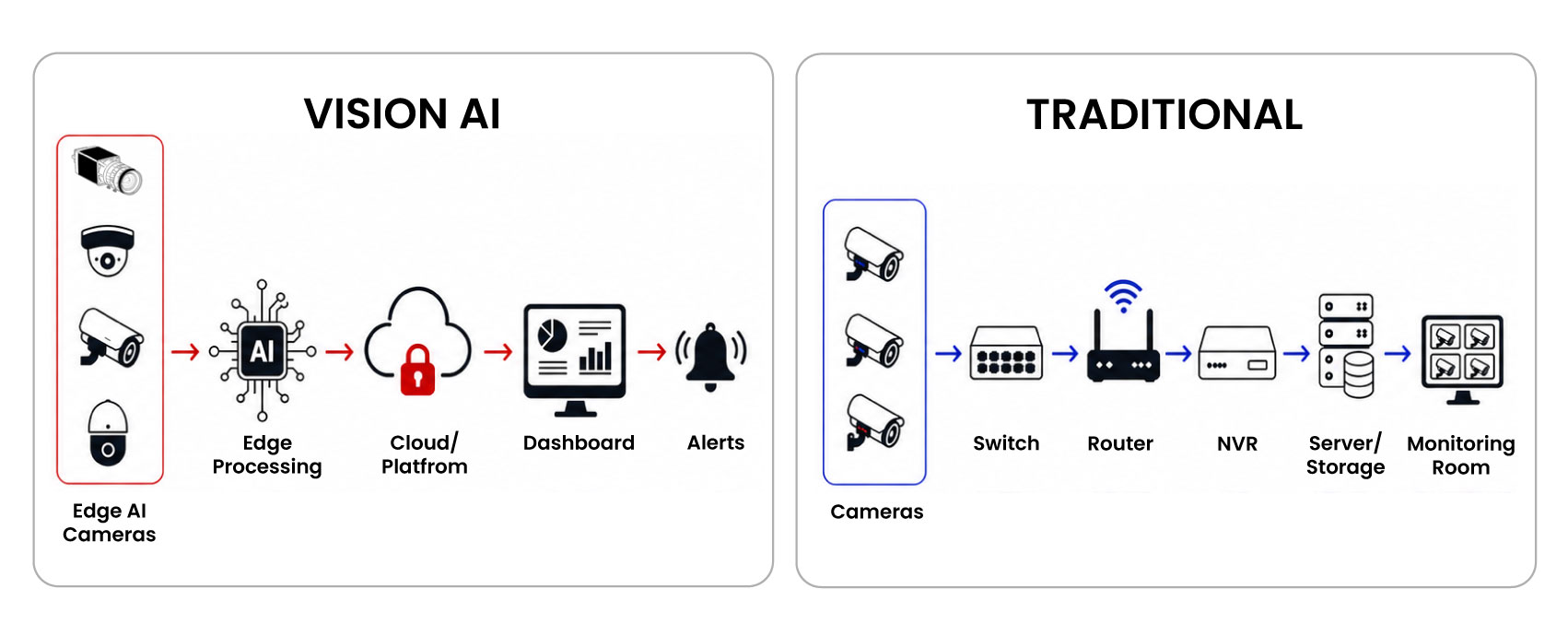
Comparing Vision AI vs Traditional Surveillance Monitoring
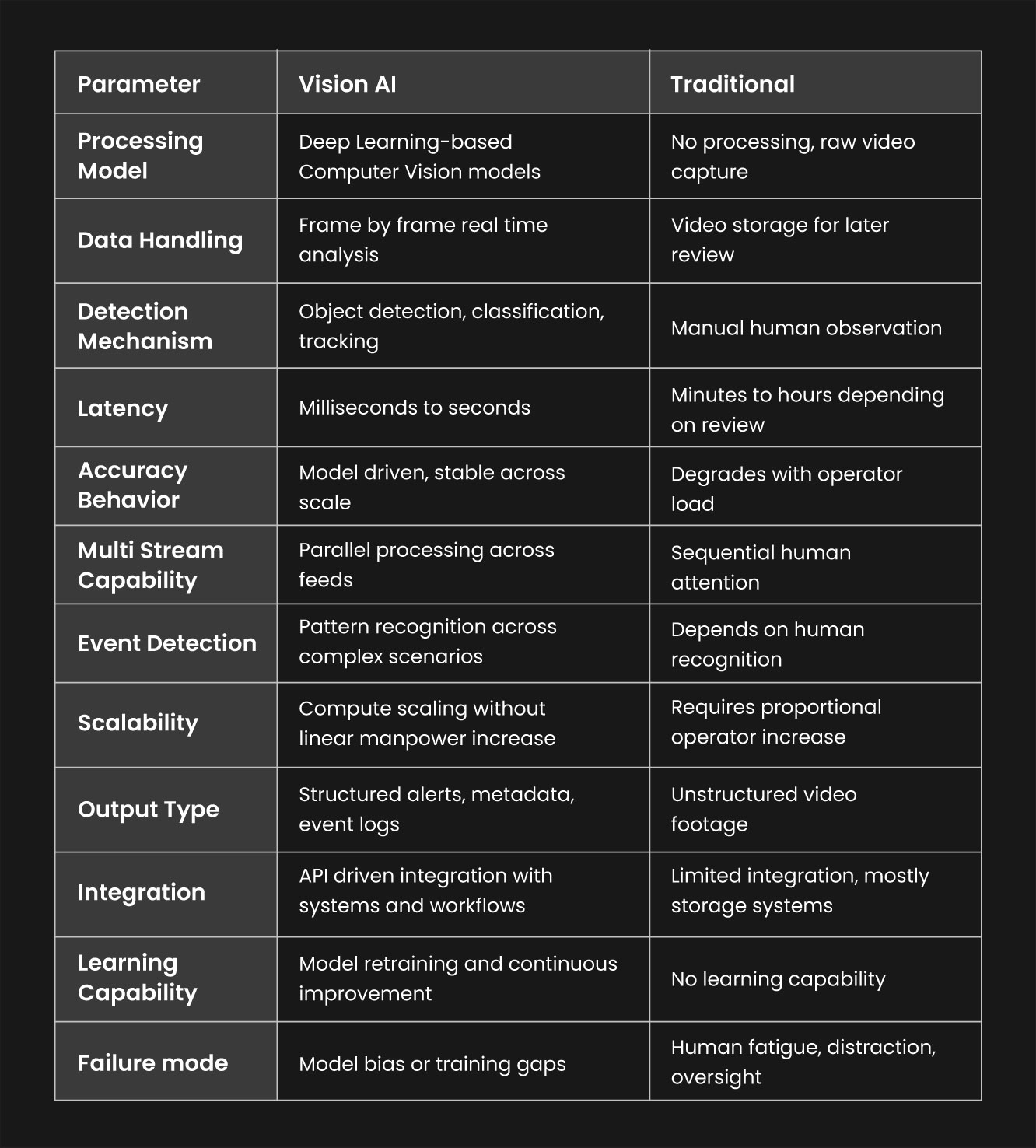
For environments where safety, quality, and compliance depend on timely detection, this difference defines whether a system records risk or reduces it.
If your current camera systems are limited to recording and review, the next step is to assess how Vision AI can improve real-time detection across safety, quality, and compliance.
Identify where delays in detection create operational risk, and where automated monitoring can reduce dependence on manual oversight.
Connect with our team to evaluate how Vision AI can be integrated into your existing camera infrastructure and workflows.