
Computer Vision in Railways for Predictive Maintenance and Safety Monitoring
Generate a quick summary


Railway networks move millions of passengers and massive volumes of freight every day. Behind every smooth train journey, coordinated inspection, monitoring, and maintenance work takes place across tracks, rolling stock, fasteners, sleepers, valves, bogies, and station environments.
For decades, railway inspections have depended on manual checks. Teams check the rails for cracks, keep an eye on the fasteners, check the wheels and keep track of safety risks for passengers. The process is still important, but it has clear problems. It takes time and costs more to do manual inspections, and they may overlook problems, especially on large, old rail networks.
That is where Computer Vision in Railways is making a practical impact.
Modern railway systems are using visual inspection technologies to support automated inspections, identify visible faults in real time, and improve predictive maintenance planning. Deep Learning, Edge Computing, thermal imaging, LiDAR, drones, and connected monitoring systems are helping rail operators improve visibility across assets and reduce risks before they become service disruptions.
This blog explores how Computer Vision in railways is improving the railway industry, from track inspection and rolling stock monitoring to safety systems and autonomous railway maintenance.
What is Computer Vision in Railways
Computer Vision helps systems analyze images and video from cameras, drones, sensors, and imaging systems.
In railway operations, Computer Vision systems review visual feeds to support defect detection, asset monitoring, safety alerts, and inspection workflows. These systems can support inspection and monitoring across:
- Railway tracks
- Sleepers and ballast
- Fasteners and bolts
- Wheels and bogies
- Valves and train components
- Passenger movement
- Track obstructions
- Grade crossings
- Station safety risks
For railway operators and infrastructure teams, the value is clear. Better visibility supports faster response, stronger asset performance, reduced downtime, and safer operations.
Why Traditional Railway Inspection Methods Are No Longer Enough
Railway infrastructure is expanding across the world. At the same time, rail networks are dealing with aging assets, higher traffic volumes, increased maintenance backlogs, stronger safety expectations, pressure to reduce downtime, and rising demand for predictive maintenance.
Traditional inspections struggle to keep pace with these demands. Manual inspection methods are labor-intensive, time-consuming, expensive, inconsistent across locations, vulnerable to oversight, and difficult to scale.
Even defects like loose fasteners, rail cracks, worn wheels, or missing bolts can escalate into major operational failures if they are not identified early.
Computer Vision supports these teams by adding an automated visual monitoring layer across infrastructure, rolling stock, and safety-critical environments.
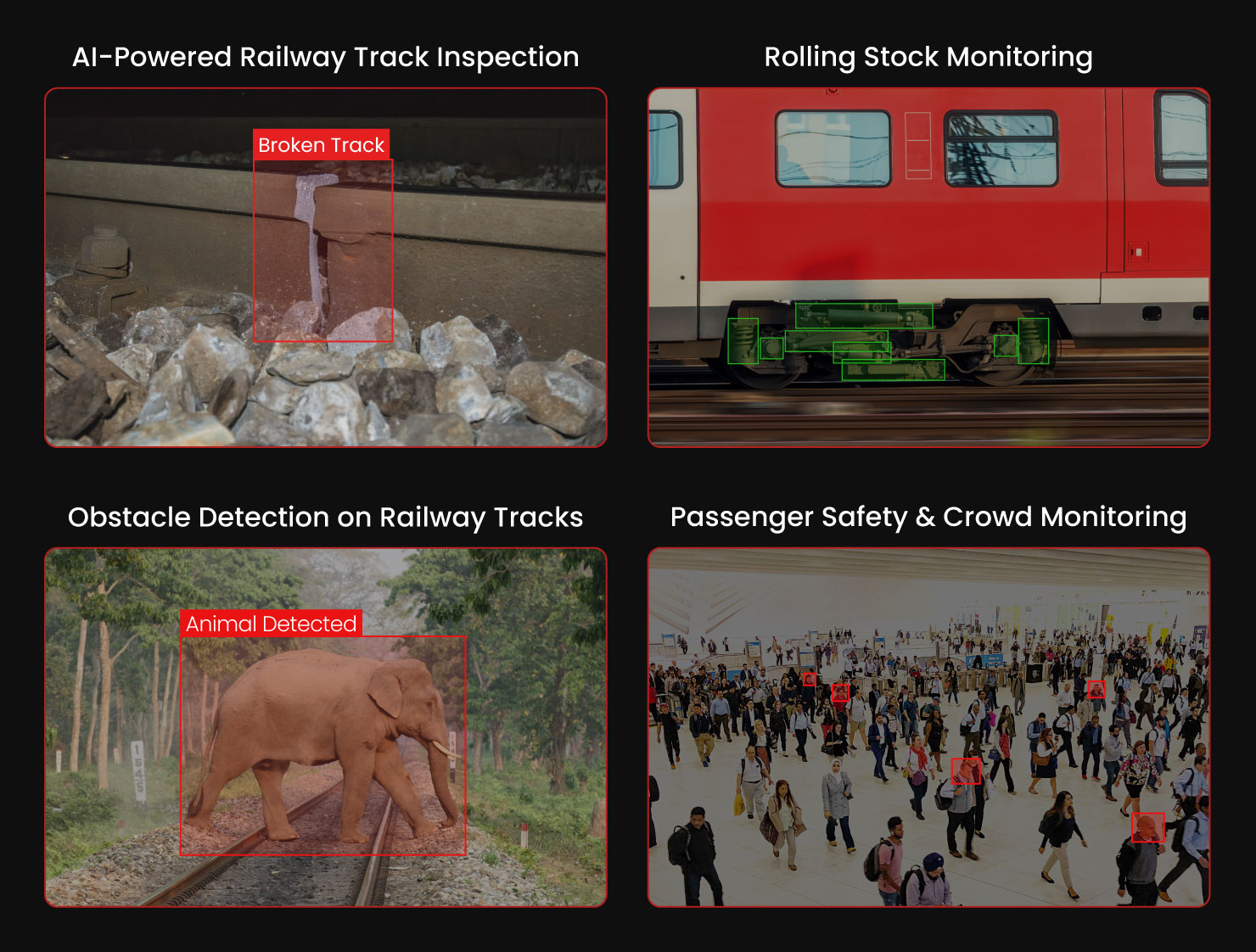
1. AI-Powered Railway Track Inspection
Track inspection is one of the most important applications of Computer Vision in railway systems. Modern visual inspection systems can support monitoring for:
- Rail surface cracks
- Corrugation
- Fastener damage
- Missing bolts
- Sleeper defects
- Ballast degradation
- Track alignment issues
- Vegetation intrusion
- Surface wear
This is where Railway Track Defect Detection using Vision AI comes in handy. It helps operators find visible signs of deterioration and make sure that the most important areas are checked before problems affect safety, uptime, or service continuity. Instead of relying only on scheduled manual inspection, rail teams can use trackside cameras, onboard cameras, and drone-based inspection to monitor critical areas with greater consistency.
Fastener and Bolt Detection
Railway fasteners are used to keep rails attached to sleepers. If fasteners are missing or damaged it can create risks. Computer Vision systems can help check the condition of fasteners find damage and flag missing or worn parts for review. This helps make decisions and allows maintenance teams to focus on what is important. Fasteners and bolts are very important for track safety. Inspecting them regularly is crucial. Edge-based inspection can also reduce delays by processing data closer to the track or train.
Sleeper and Ballast Monitoring
Monitoring sleepers and ballast is important for track stability. Sleepers and ballast help keep the track stable. Computer Vision systems can help monitor:
- Sleeper cracks
- Ballast fouling
- Mud accumulation
- Vegetationgrowth
- Surface degradation
Combining camera feeds with sensors or other inspection inputs, railway teams can get a better view of track conditions. This helps them find signs of instability.
Rail Crack Detection
Rail surface cracks are a safety concern for railways. Visual inspection systems can help detect surface irregularities, cracks, and visible damage patterns across rail assets. This gives railway teams better support for early review, maintenance planning, and safety response. These systems do not replace engineering judgment. They support teams with faster review, wider coverage, and fewer blind sp
2. Rolling Stock Monitoring with Computer Vision
Computer Vision is not limited to railway tracks but also for inspecting and maintaining rolling stock. This visual inspection can help with checking train parts like
- Wheels
- Bogies
- Axles
- Suspension systems
- Brake components
- Isolation valves
- Load weigh valves
- Engine bolts
Rolling stock is always getting worn out. If there is a problem with the wheels, brakes, bogies or other mechanical parts it can affect how well the trains run, the safety of the passengers and the cost of maintenance. With Vision AI, the railway team can check for signs of wear where that are not aligned properly overheating, missing parts and other risk that could be a problem. They can do this in a consistent way.
Bogie and Wheel Fault Detection
High-speed imaging and visual analytics can support monitoring of moving bogie and wheel components. Inspection teams can use these systems to review visible conditions across axles, suspension springs, support rods, binding screws, and connected components. When combined with thermal data or other sensor inputs, Vision AI can help identify abnormal conditions earlier. For operators, the business outcome is clear. Better inspection coverage, fewer missed defects, stronger asset availability, and reduced unplanned downtime.
Valve and Mechanical Component Inspection
The railway systems have thousands of mechanical parts that need to be checked regularly. Computer Vision systems can help with checking isolation valves, pneumatic hose connections train height valves, fastening bolts and brake components. This helps the maintenance teams do their inspections in a consistent way whether they are working in the depot on the trains or during scheduled maintenance.
3. Railway Obstruction Detection and Safety Monitoring
Railway safety extends beyond infrastructure. Computer Vision also supports monitoring of passengers, trespassing risks, track obstructions, platform activity, and station safety. This is an important part of AI-Powered Inspection because rail operators need to identify operational risks in real time, not after an incident has already disrupted service.
Obstacle Detection on Railway Tracks
Railway environments can face risks from:
- Animals crossing the track
- Tools left on tracks
- Fallen debris
- Vegetation intrusion
- Unauthorized vehicles
- Track obstructions
- Maintenance hazards
Computer Vision systems can monitor these risks using trackside cameras, onboard cameras, and drone-based inspection. When a potential obstruction is detected, operators can receive alerts for faster review and response. This helps reduce incident risk, service delays, and operational uncertainty.
4. Passenger Safety and Crowd Monitoring
Railway stations can become high-risk environments during peak traffic periods. Computer Vision systems can support:
- Overcrowding detection
- Passenger flow monitoring
- Unsafe behavior identification
- Slip and fall detection
- Trespassing alerts
- Platform safety monitoring
For passenger rail, metro, LRT, and station operators, real-time visibility can improve staff response and strengthen safety management. This is where AI in Transportation becomes especially relevant. The goal is to connect infrastructure monitoring, passenger safety, asset inspection, and operational intelligence into a stronger decision-making layer.
Why Real-Time Processing Matters in Railway Inspection
Railway inspection systems generate large volumes of visual and sensor data. Processing that data quickly is critical. Edge AI helps by analyzing selected visual feeds closer to where the data is captured. This can reduce delay and support faster alerts. Railway operators are increasingly using:
- Edge AI devices
- Embedded AI hardware
- Real-time video processing
- Connected monitoring dashboards
- Cloud-linked maintenance systems
These technologies help teams move from delayed reporting to faster operational awareness. For senior leaders, the business value is clear. Real-time processing improves response speed, supports governance, improves safety oversight, and gives teams better control across distributed rail assets.
LiDAR, Thermal Imaging, and Multi-Sensor Fusion
Modern rail inspection does not depend only on standard RGB cameras. Railway teams are combining multiple sensing technologies, including:
- LiDAR
- Thermal imaging
- Infrared sensors
- Stereo vision
- UAV imaging
- Vibration sensors
- IoT monitoring systems
This multi-sensor approach can improve defect visibility, low-light performance, environmental robustness, predictive maintenance accuracy, and obstacle detection. LiDAR is useful for creating 3D visibility into track geometry, infrastructure conditions, and surrounding environments.
Key Considerations Before Deploying Vision AI in Rail Operations
Vision AI can create strong value across rail inspection, safety monitoring, and predictive maintenance when it is aligned with real operating conditions. Before deployment, rail operators should consider camera placement, lighting conditions, data quality, alert workflows, system integration, and how inspection insights will connect with maintenance teams.
A practical rollout usually starts with high-value use cases such as track monitoring, rolling stock inspection, platform safety, or drone-based infrastructure inspection. From there, teams can validate performance, tune alerts, and scale the system across wider rail operations. This approach helps rail teams move from visual monitoring to actionable intelligence while keeping safety, reliability, and operational continuity at the center.
Autonomous Railway Inspection Is Becoming a Reality
Railway operators are moving toward more automated inspection environments. Common developments include:
- AI-powered drones
- Autonomous inspection robots
- Real-time edge AI systems
- Smart monitoring platforms
- Cloud-connected maintenance systems
Future railway maintenance will rely on systems that can help identify defects earlier, support failure prediction, guide maintenance scheduling, reduce downtime, improve passenger safety, and strengthen connected rail networks. Computer Vision is becoming a key technology behind intelligent railway infrastructure.
Final Thoughts
Computer Vision is changing how railway systems approach inspection, maintenance, and operational safety. From track inspection and rolling stock monitoring to passenger safety and autonomous inspection systems, AI-powered visual inspection helps railway operators improve accuracy, reduce inspection costs, and detect issues before they become major failures. The industry is moving toward continuous monitoring, predictive maintenance, real-time alerts, and data-backed safety decisions.
For railway operators, infrastructure leaders, transportation executives, maintenance teams, and technology decision-makers, Computer Vision in Railways is no longer a future concept. It is becoming a practical foundation for safer, smarter, and more resilient rail operations.
Looking to upgrade railway inspection and reduce unplanned downtime? Explore how Vision AI can improve visibility across tracks, rolling stock, stations, and safety-critical infrastructure.