
Edge AI vs Cloud AI Choosing the Right Deployment Model for Enterprise Computer Vision
Generate a quick summary


As enterprise Computer Vision moves from pilots to production, one decision becomes critical: where should AI processing happen?
For organizations using Computer Vision across factories, warehouses, retail stores, healthcare facilities, transportation networks, and energy sites, deployment architecture affects response time, bandwidth cost, data privacy, connectivity, infrastructure planning, and long-term scalability.
Edge AI and Cloud AI both support enterprise Computer Vision, but they solve different problems. Edge AI runs models close to cameras, sensors, gateways, or local devices. Cloud AI runs models and manages AI workloads through centralized cloud infrastructure. The right choice depends on the use case, operating environment, performance requirement, and governance needs.
Core Differences Between Edge AI and Cloud AI
Unlike many enterprise applications, Computer Vision systems continuously process large volumes of visual data generated by cameras and sensors. Every camera feed can create a constant stream of images or video that must be processed quickly enough to support operational decisions.
In manufacturing, delayed defect detection can affect production quality. In warehouses, slower safety alerts can increase operational risk. In healthcare, sending sensitive visual data outside controlled environments can create privacy and compliance concerns.
These realities make Edge AI vs Cloud AI a deployment decision with direct operational impact.
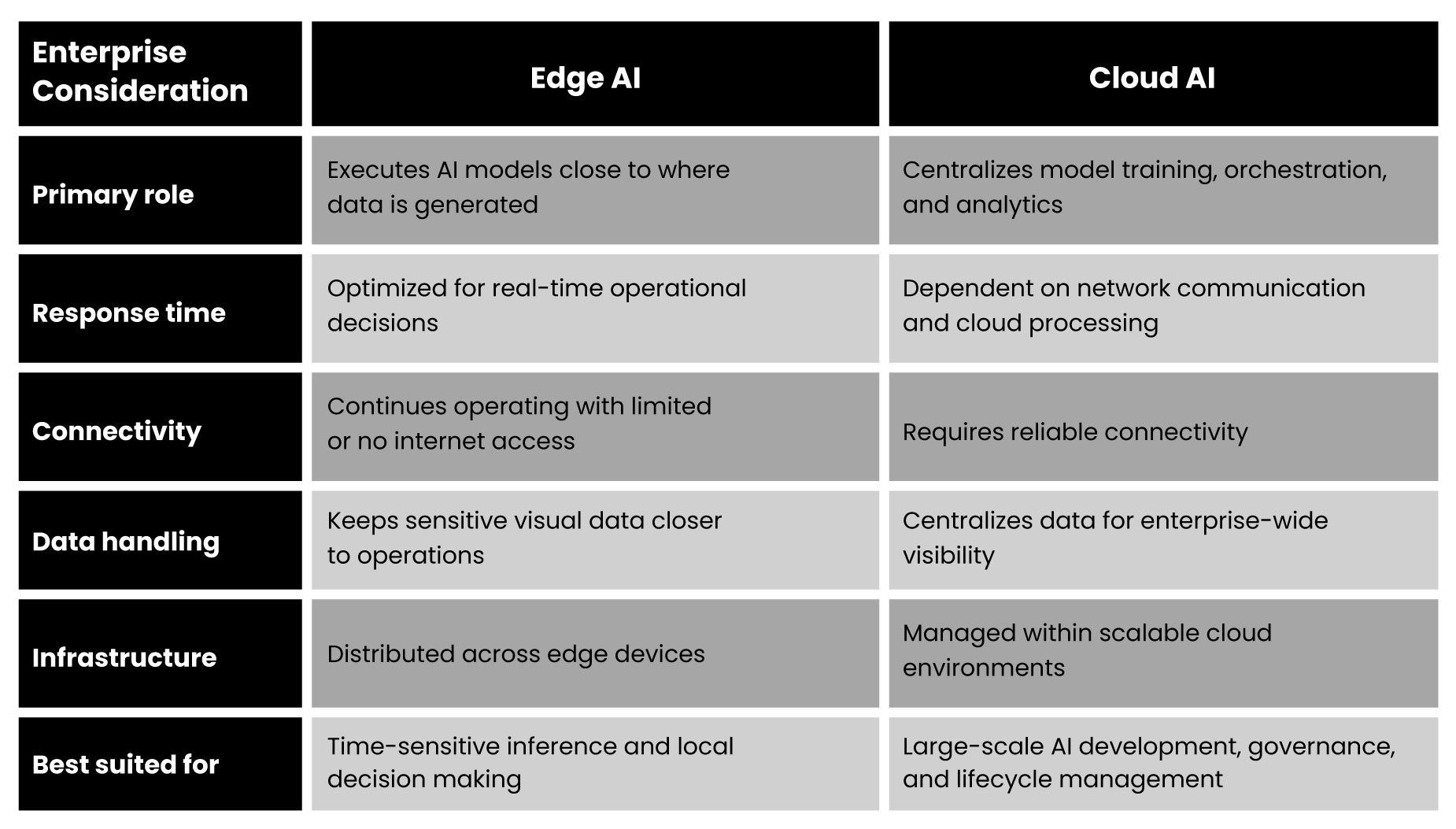
The comparison shows that Edge AI and Cloud AI are not interchangeable. Edge AI is better suited for real-time inference, local decision-making, limited connectivity, and sensitive visual data. Cloud AI is better suited for model training, centralized governance, large-scale analytics, and lifecycle management.
Why Enterprises Choose Edge AI for Computer Vision
Enterprises choose Edge AI when Computer Vision systems need to respond quickly, operate locally, or reduce dependence on network connectivity.
In edge environments, visual data is processed near the source. Instead of sending every image or video frame to the cloud, the edge device analyzes the data locally and sends only the required output. That output may be a defect alert, safety violation, occupancy count, quality score, or operational event.
This is especially valuable for video-heavy environments. Continuously streaming high-resolution footage to the cloud can increase bandwidth usage, infrastructure cost, and system latency. Edge AI reduces this pressure by keeping most processing local.
For example, a factory inspection system does not need to upload every frame from a production line. It only needs to report when a defect is detected. A workplace safety system does not need to stream continuous video for every camera. It can issue alerts when it identifies a hazard, restricted-zone entry, missing PPE, or unsafe movement.
A successful Edge AI deployment also improves continuity. In remote facilities, mobile environments, energy sites, transportation networks, or manufacturing floors with unstable connectivity, cloud-only systems can become unreliable. Edge AI allows Computer Vision systems to continue operating even when the network is slow, limited, or temporarily unavailable.
Data privacy is another major reason enterprises move AI processing to the edge. Visual data can include faces, license plates, medical images, facility layouts, equipment, or sensitive operational activity. Processing this data locally reduces unnecessary exposure and helps organizations maintain stronger control over what leaves the site.
For enterprise Computer Vision, Edge AI is not just about speed. It supports faster decisions, lower bandwidth dependency, stronger privacy control, and more consistent operations in real-world environments.
Why Cloud AI Remains Essential for Enterprise Computer Vision
Cloud AI remains essential because enterprise Computer Vision does not end with inference.
Before models can run at the edge, they must be trained, tested, optimized, monitored, updated, and governed. These activities require centralized infrastructure, scalable compute, storage, collaboration tools, and lifecycle management. That is where Cloud AI deployment plays a critical role.
Cloud environments are well suited for training large models, managing datasets, comparing model versions, monitoring performance, and analyzing results across multiple locations. They also help enterprises maintain governance standards by centralizing access control, auditability, model updates, and performance visibility.
Major cloud platforms support these needs in different ways. AWS provides services such as Amazon SageMaker for model development, deployment, and monitoring, along with Amazon Bedrock for foundation model access. Microsoft Azure supports enterprise AI through Azure Machine Learning and Azure AI Foundry, with strong alignment to regulated and security-conscious environments. Google Cloud Vertex AI supports model development, deployment, and large-scale training workflows. Oracle Cloud Infrastructure is used by organizations that need GPU-powered environments, data residency options, or alignment with existing Oracle systems.
For enterprise Computer Vision, the cloud acts as the control layer. It helps teams build better models, manage deployment pipelines, monitor performance, and improve AI systems over time.
Edge AI Deployment Platforms
Edge AI requires both hardware and software that can run AI models efficiently outside the cloud.
On the hardware side, platforms such as NVIDIA Jetson are widely used for advanced Computer Vision workloads, robotics, industrial automation, intelligent surveillance, and real-time video analytics. Google Coral supports low-power AI inference through its Edge TPU, making it useful for compact and energy-conscious deployments. Raspberry Pi paired with Intel Neural Compute Stick 2 is commonly used for prototyping, testing, and lightweight edge AI use cases.
On the software side, models need optimization before they can run efficiently on edge devices. Frameworks such as Edge Impulse, Intel OpenVINO, and Google LiteRT help teams prepare models for constrained hardware by improving performance, reducing model size, and supporting deployment across different device environments.
This matters because edge devices do not have the same compute capacity as cloud infrastructure. A model that performs well in the cloud may be too heavy for an edge device unless it is optimized. Enterprises must consider model size, inference speed, power consumption, hardware compatibility, update management, and long-term maintenance before scaling Edge AI deployment.
When to Use Edge AI and When to Use Cloud AI
The best deployment model depends on the business problem and operating environment.
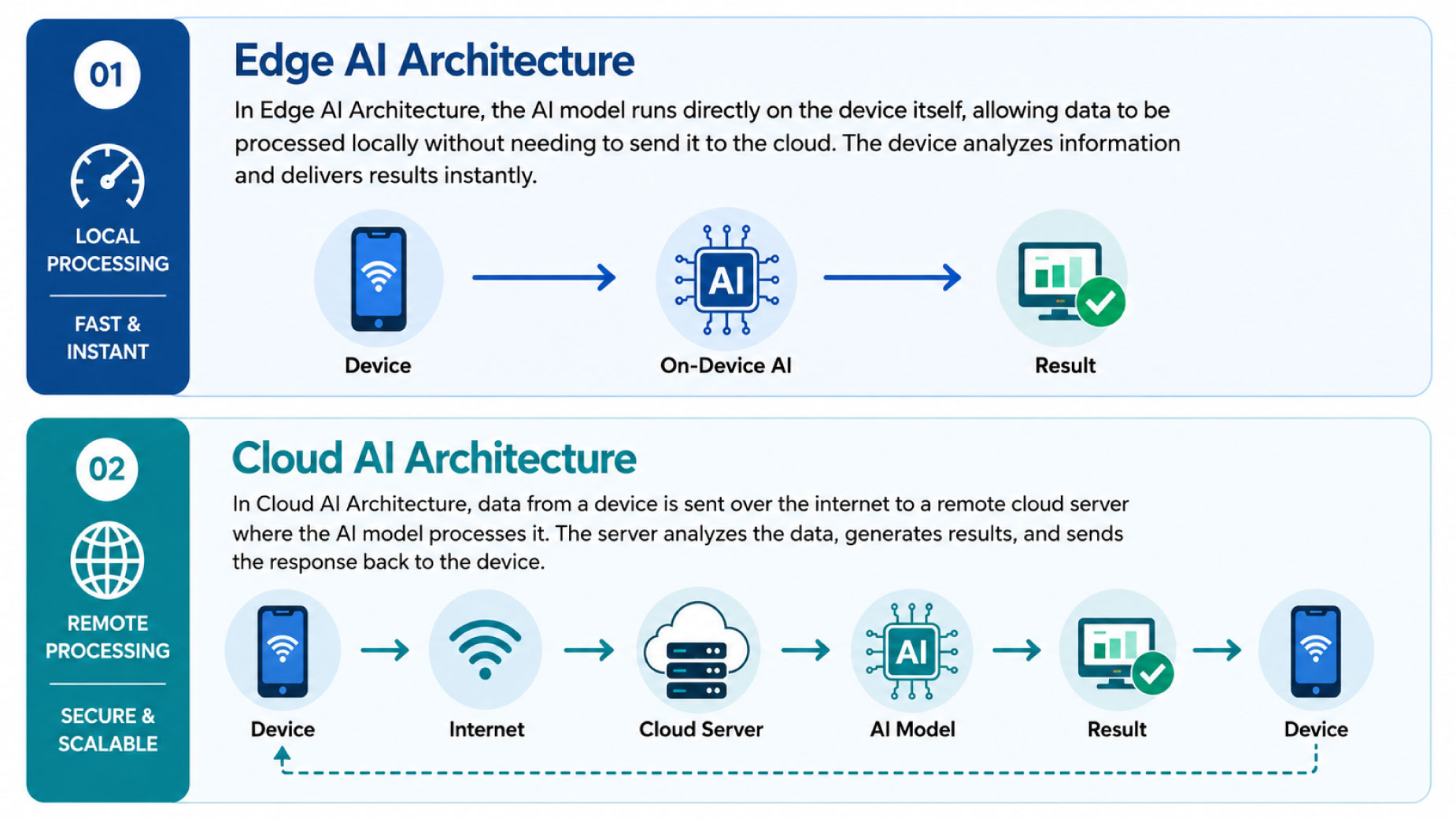
Edge AI is the stronger fit when the use case requires immediate response, local processing, or low network dependency. This includes quality inspection, safety monitoring, access control, equipment monitoring, autonomous systems, traffic analysis, and visual inspection in remote or distributed environments.
Cloud AI is the stronger fit when the workload depends on centralized compute, advanced analytics, large-scale model training, enterprise governance, or visibility across multiple locations. This includes model development, retraining, historical analysis, performance monitoring, model versioning, and executive reporting.
In many enterprise Computer Vision deployments, the practical answer is not Edge AI or Cloud AI alone. A hybrid AI architecture combines both. The cloud is used to train, manage, and improve models. The edge is used to run optimized models locally and support real-time decisions.
For example, a manufacturer may train inspection models in the cloud, deploy them to edge devices on production lines, process images locally, and send only defect counts or quality metrics back to centralized dashboards. A retailer may process shopper movement locally to reduce privacy exposure while sending anonymized insights to the cloud for store-level analytics. A healthcare organization may keep imaging data within secure clinical environments while using the cloud to manage model updates across facilities.
For many enterprise Computer Vision deployments, combining edge and cloud capabilities allows organizations to balance real-time performance with centralized AI management.
Choosing the Right Computer Vision Deployment Strategy
Choosing the right Computer Vision deployment strategy starts with understanding the operational requirement.
If the system needs real-time response, local data control, offline functionality, or reduced bandwidth usage, Edge AI is usually the better fit. If the system needs large-scale training, centralized analytics, model governance, and continuous improvement, Cloud AI is usually the better fit.
Enterprises should evaluate five practical questions before deciding:
- Does the use case require immediate action?
- Can the network support continuous image or video transfer?
- Does visual data need to stay close to the source?
- How often will models need to be updated or retrained?
- Will the deployment scale across multiple sites?
These questions help determine whether the workload should run at the edge, in the cloud, or through a combined deployment model.
The strongest enterprise Computer Vision systems are designed around workload requirements, not technology preference. Edge AI delivers speed, privacy, and operational continuity. Cloud AI delivers scale, governance, and model improvement. Used together, they help enterprises deploy Computer Vision systems that are faster, more efficient, and easier to manage across distributed operations.
Planning Your Enterprise Computer Vision Strategy
Every organization has different infrastructure, data governance needs, connectivity constraints, and operational priorities. Choosing between Edge AI and Cloud AI requires more than comparing technologies. It requires understanding how deployment architecture affects day-to-day performance and long-term scalability.
ImageVision.ai helps enterprises evaluate the right deployment model for Computer Vision initiatives across manufacturing, logistics, retail, healthcare, energy, and other operational environments.
Talk to Our Vision AI Experts to explore how the right Edge AI and Cloud AI deployment strategy can improve operational performance, strengthen data governance, and support scalable Computer Vision across your enterprise.