

Evaluating AI Visual Inspection for High-Volume Manufacturing
Generate a quick summary


In high-volume manufacturing, inspection errors carry consequences beyond the production line. Defective products that reach customers can generate returns, complaints, and corrective action costs. Incorrect rejection creates a different expense by diverting acceptable products into rework, manual review, or disposal.
AI visual inspection applies Computer Vision and AI models to assess visible product characteristics against defined quality requirements. Its value lies in identifying relevant defects consistently, maintaining inspection performance at production speed, and providing information for timely quality decisions.
Selecting an inspection solution requires an understanding of quality costs, defect characteristics, imaging conditions, system integration, and the evidence needed to support deployment.
Start with the Cost of Inspection Errors
Manufacturing quality control is both a technical requirement and a financial consideration. The cost of inspection includes resources spent checking products and the consequences of quality failures.
The American Society for Quality’s cost of quality framework organizes these expenditures into four categories.
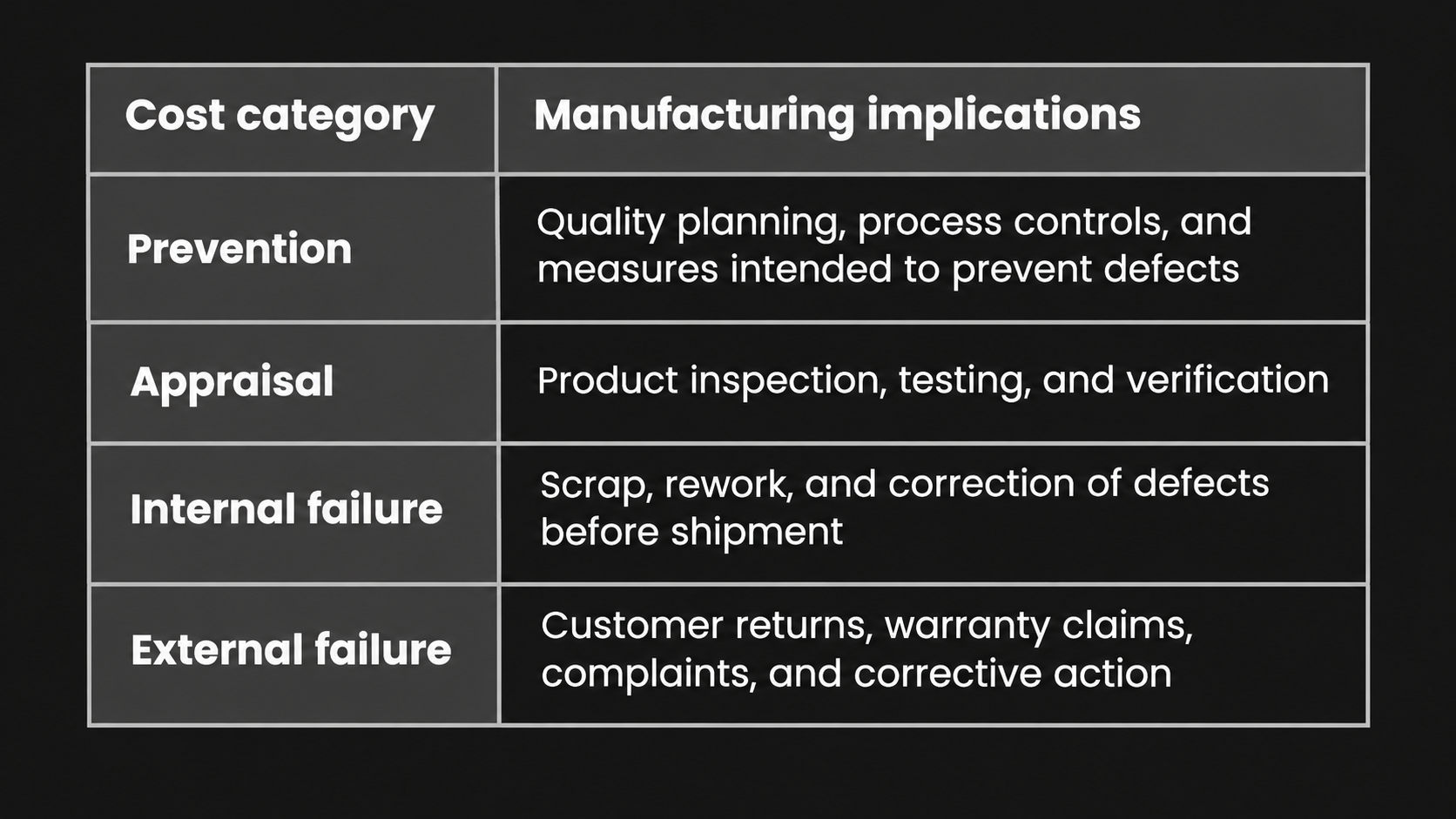
Visual inspection falls primarily within appraisal activities. Its purpose is to assess whether products meet specified requirements. Findings from inspection can also help quality teams identify recurring defects and investigate their causes.
The financial case for Vision AI should therefore examine where inspection improvements could reduce quality-related losses or verification effort.
A useful baseline includes defect escape rates, false rejection rates, scrap, rework, manual inspection hours, and customer-related quality costs.
These measures allow manufacturers to compare the existing inspection process with results demonstrated during production trials.
Define Defect Detection Requirements Before Technology Selection
Inspection performance depends on having a precise definition of what constitutes a defect.
A cosmetic variation may fall within product specifications, while an incorrect label, missing component, or damaged package may require rejection. Each condition presents a different inspection requirement and level of business risk.
Effective defect detection begins with identifying the relevant defect categories, acceptable variations, minimum defect sizes, and product surfaces requiring inspection.
Consider a beverage bottling facility producing multiple SKUs. Quality checks may include label alignment, cap placement, product identification, and visible packaging damage.
Although these inspections occur on the same production line, their imaging requirements differ. Transparent containers introduce reflections, labels vary across product configurations, and moving products must be captured at the appropriate position.
ImageVision.ai’s packaging inspection capabilities cover applications involving label inspection, package defects, barcode verification, and seal inspection.
Defining the inspection scope also means establishing what the imaging setup can observe. A camera inspecting one side of a product cannot evaluate a concealed surface. Requirements involving internal defects or characteristics outside the camera’s view may require additional inspection methods.
Clear specifications help ensure that the proposed Vision AI solution addresses the actual quality requirement.
Evaluate Computer Vision Performance Under Production Conditions
A Vision AI model may classify test images correctly, but production inspection depends on the complete imaging and processing setup.
Computer Vision quality control requires cameras, optics, illumination, image capture, and processing infrastructure to operate together under production conditions.
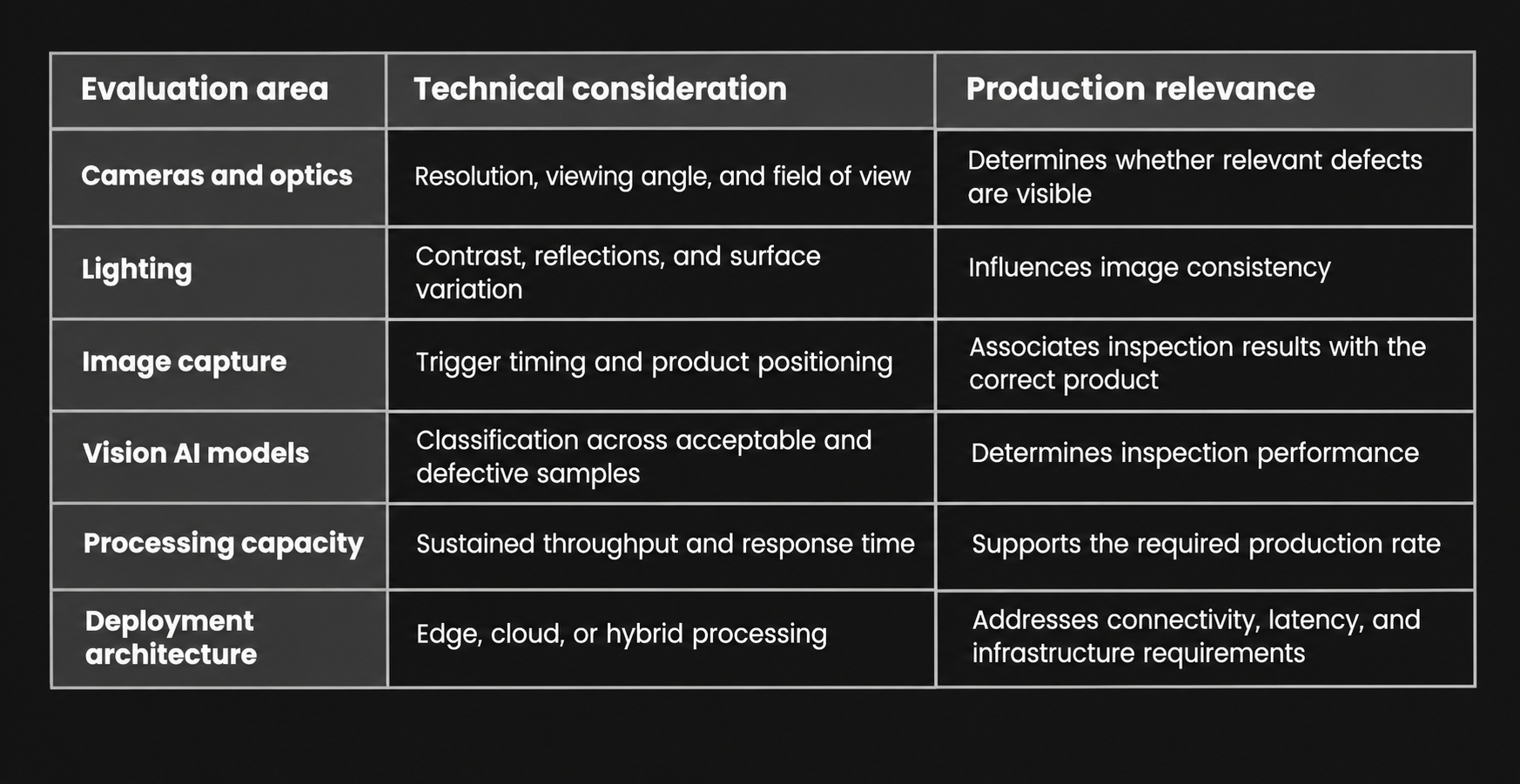
Image quality becomes particularly important at higher production speeds. Longer exposure times can introduce motion blur when capturing moving products, as explained in Basler’s image quality documentation. Camera exposure and lighting must therefore be configured together to capture the detail required for inspection.
Production trials should account for normal and maximum line speeds, product spacing, orientation, lighting variation, and SKU changes.
The objective is to establish whether relevant defects remain distinguishable under the conditions in which inspection will take place.
Measure Inspection Performance Beyond Overall Accuracy
A single accuracy percentage does not fully explain how an inspection solution performs.
Consider an illustrative sample of 10,000 products containing 100 defective units.
A system that accepts every product would achieve 99% overall accuracy while missing all 100 defects.
This example highlights the importance of evaluating different classification outcomes.
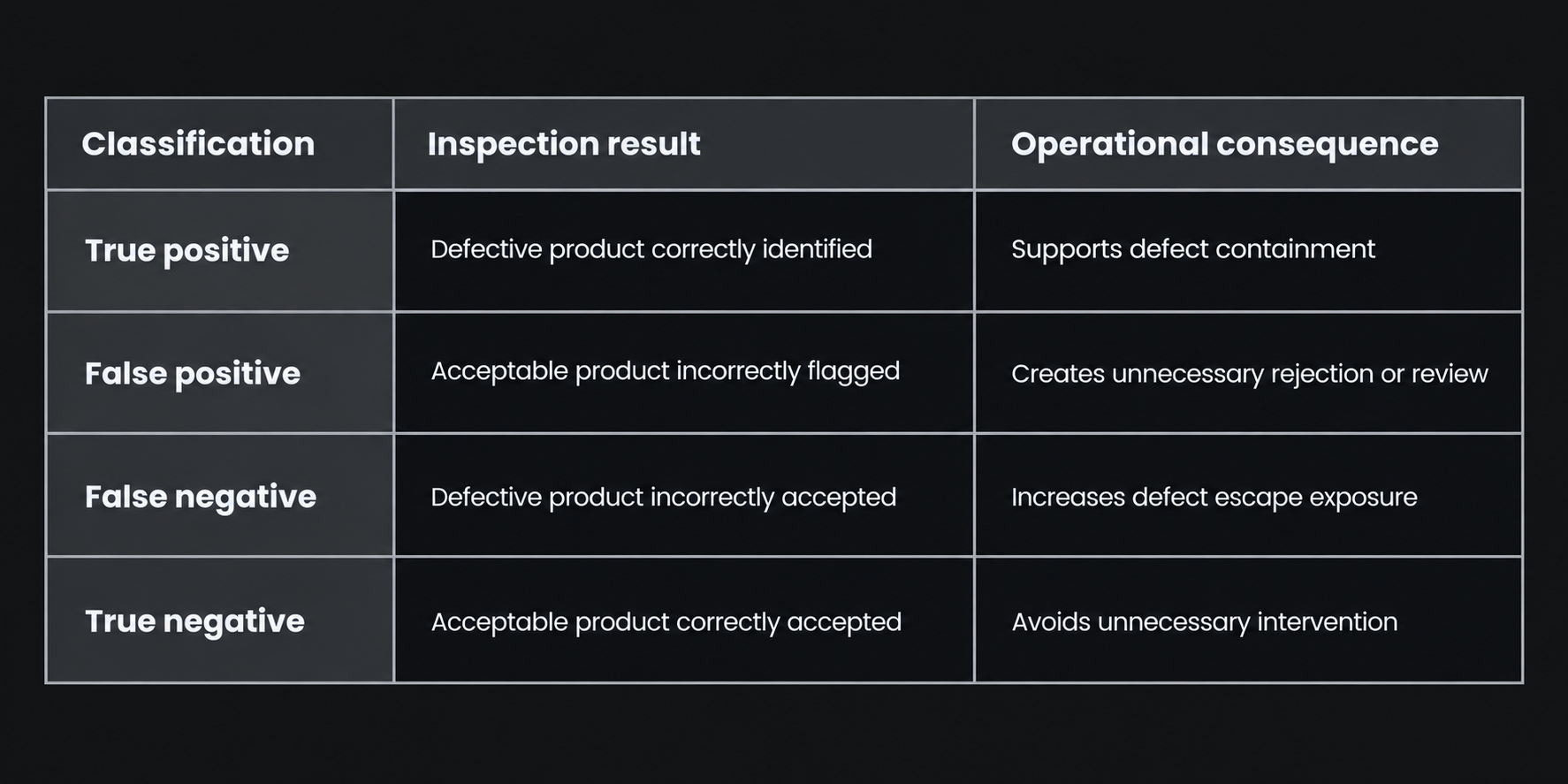
Two performance measures deserve particular attention.
Defect detection rate, also called recall, measures the proportion of defective products correctly identified.
False rejection rate measures the proportion of acceptable products incorrectly flagged.
These metrics represent different operational consequences. Missing a critical defect can generate substantial downstream costs, while excessive rejection increases waste and verification effort.
Manufacturers should define acceptance thresholds according to defect severity and product requirements.
Validation should use independently labeled samples excluded from model training and tuning. Results should be reported by defect category and SKU, with sample counts and test conditions documented.
Trials containing deliberately increased defect proportions should be reported separately from trials using representative production samples.
This provides a clearer understanding of inspection performance and the risks that remain after testing.
Connect Inspection Findings to Production Decisions
An inspection result becomes operationally useful when it reaches the appropriate system or personnel within the available response time.
Depending on the manufacturing process, Vision AI may need to exchange data with programmable logic controllers (PLCs), manufacturing execution systems (MES), and quality management systems (QMS).
Three requirements are central to integration.
- Product traceability: Inspection findings should be associated with the correct product, batch, SKU, or production event. This supports quality investigations and production records.
- Response timing: Results must be communicated within the production decision window. Where rejection equipment is used, the signal must reach the appropriate system before the product passes the rejection point.
- Exception handling: Missed triggers, unreadable images, communication interruptions, and application downtime require defined responses. Products without valid inspection results should be handled according to the approved quality procedure.
Where inspection findings initiate physical rejection, testing should verify that the intended product is removed or segregated. Correct classification alone does not establish successful rejection.
ImageVision.ai’s quality verification applications include surface defect detection, barcode and label inspection, fill-level checks, and package closure inspection.
Connecting inspection findings with production processes allows quality information to support immediate decisions, traceability, and subsequent analysis.
Assess Total Cost and Enterprise Scalability
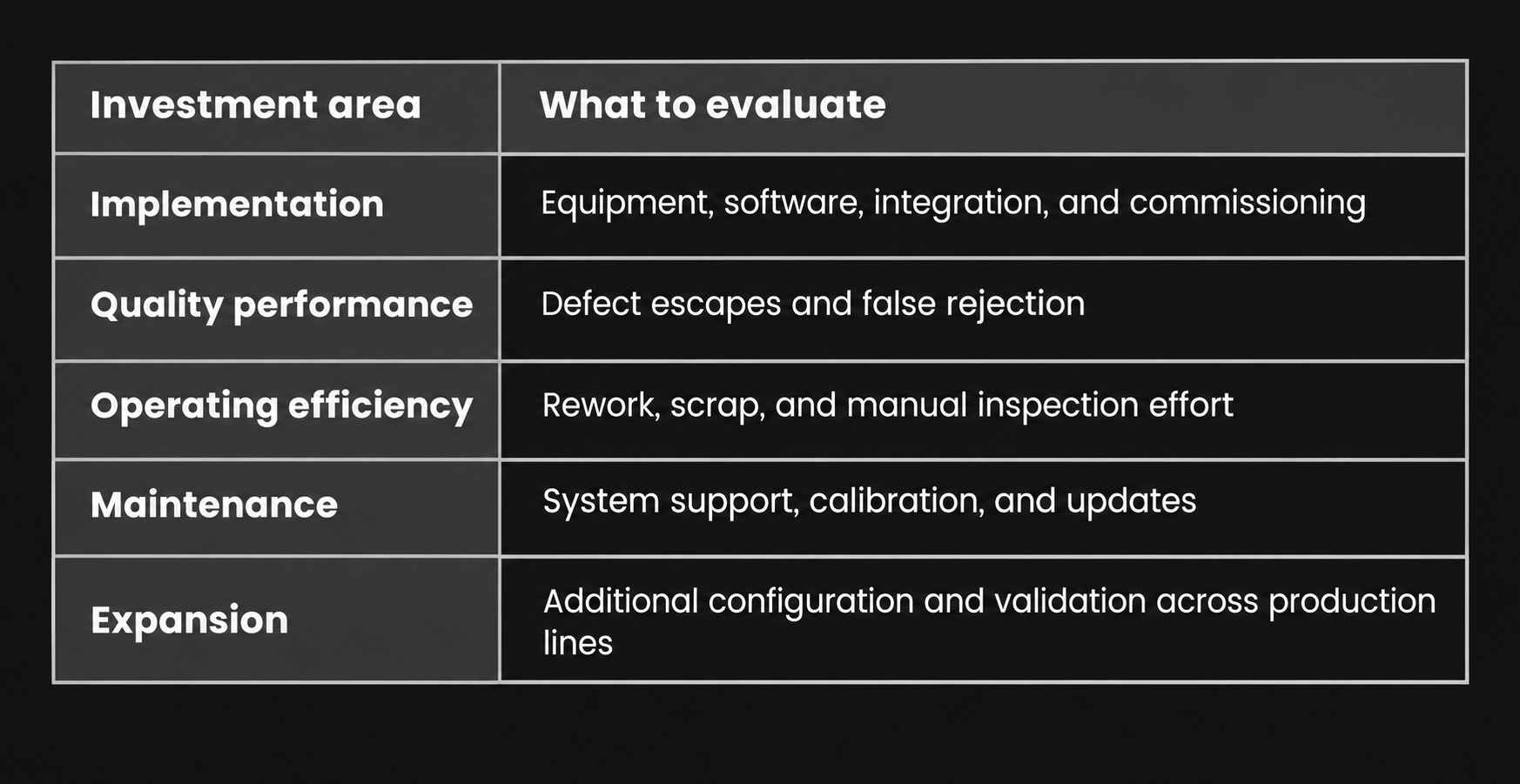
The investment case for Vision AI inspection should consider the full cost of deployment and ongoing operation.
Initial expenditure may include imaging equipment, lighting, computing infrastructure, software, integration, commissioning, and operator training. Recurring costs may include maintenance, infrastructure operation, technical support, and performance validation.
These expenses should be compared with measurable changes in quality performance and operating costs.
Results demonstrated on one production line should not automatically be extended to other facilities.
Differences in products, equipment layout, lighting, and operating conditions may require changes to the inspection configuration.
Enterprise scalability therefore depends on deployment planning, configuration control, maintenance responsibilities, and procedures for reassessing inspection performance when production conditions change.
A sound financial assessment distinguishes expected benefits from improvements supported by production data.
Establish Acceptance Criteria Before Deployment
Industrial visual inspection should be validated against documented quality and production requirements before operational approval.
Factory acceptance testing can confirm configured functionality under agreed test conditions. Site acceptance testing should verify performance with installed equipment, actual production conditions, and required interfaces.
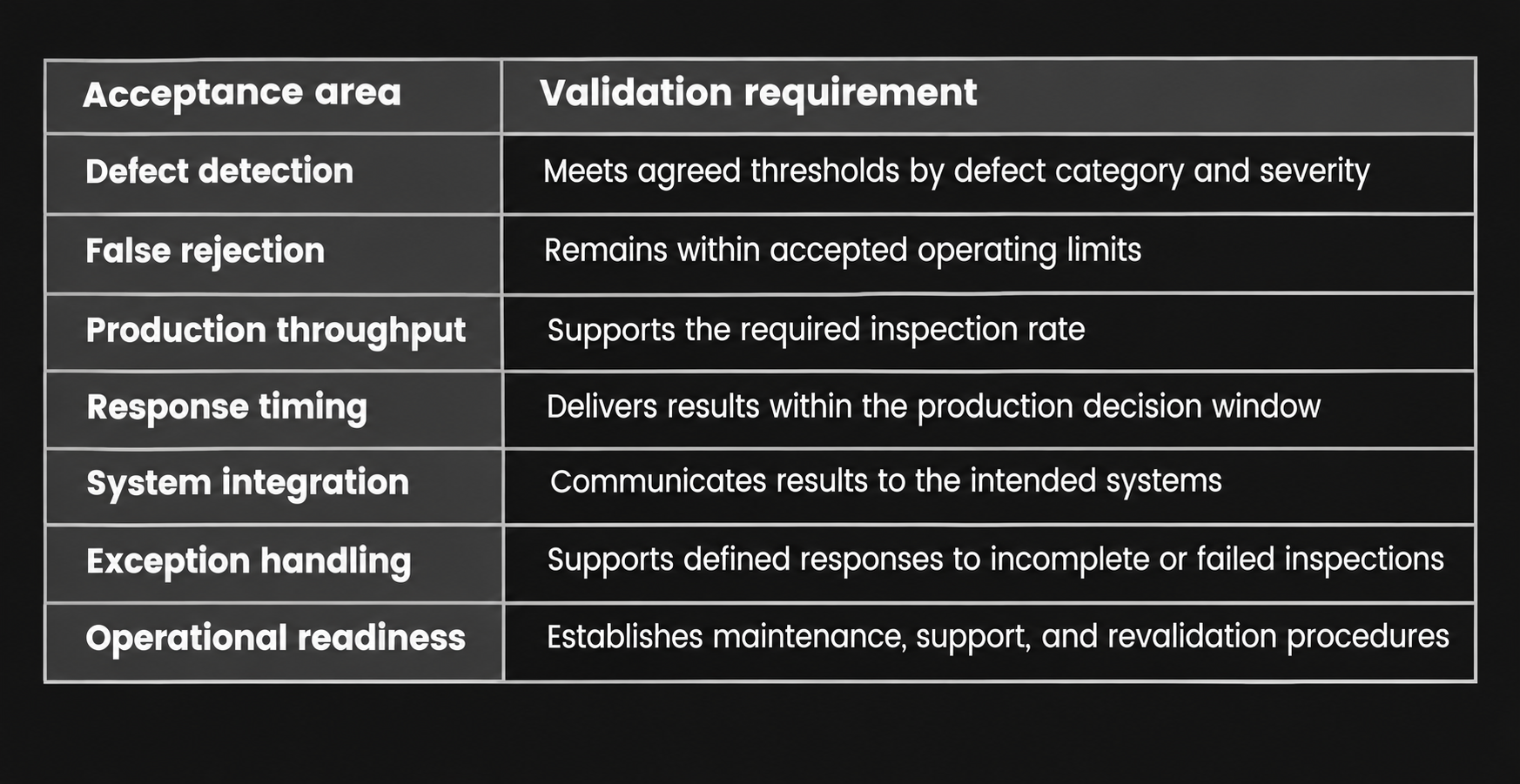
Approval should be based on three findings.
- Inspection capability confirms that relevant defects can be identified under representative operating conditions.
- Production suitability confirms that inspection results arrive in time and support the required downstream response.
- Operational readiness confirms that quality teams can manage exceptions, maintain the system, and reassess performance following significant production changes.
Together, these findings provide a practical basis for deciding whether a Vision AI inspection solution is ready for production use and subsequent expansion.
Discuss Your Manufacturing Inspection Priorities
Vision AI inspection can support manufacturing quality objectives when the technology is selected against clearly defined inspection requirements, production conditions, and performance criteria.
ImageVision.ai provides Enterprise Computer Vision and Vision AI solutions for manufacturing and industrial operations, including packaging inspection, defect detection, and quality verification.
Talk to a Vision AI Expert to discuss your production inspection requirements and integration priorities.