

Drilling Rig Safety Monitoring with Vision AI for Onshore Oil and Gas Operations
Generate a quick summary


Onshore drilling operations involve continuous interaction between personnel, heavy equipment, and hazardous work areas. Maintaining visibility across rig floors, pipe-handling zones, and controlled access points is essential to effective safety oversight.
According to the International Association of Drilling Contractors (IADC) 2025 Annual Incident Statistics Report, participating drilling contractors worldwide reported 9 fatalities, 227 lost-time incidents, and 832 recordable incidents in 2025, covering both onshore and offshore operations.
Drilling Rig Safety Monitoring with Vision AI enables onshore operators to analyze camera feeds, identify predefined safety and security events, and generate alerts that support operational response.
Why Is Real-Time Safety Monitoring Important at Onshore Drilling Rigs?
Rig floors, tubular-handling systems, rotating machinery, and vehicle movements create environments where personnel may work close to hazardous equipment.
Restricted sightlines, dust, changing lighting conditions, and simultaneous activities can make continuous observation challenging. Conventional CCTV provides visual coverage, but identifying specific events still depends on operator attention.
Vision AI complements existing surveillance infrastructure by detecting configured events that require investigation. This supports hazardous-zone oversight, incident review, and consistent safety monitoring practices without replacing established engineering controls or safety procedures.
Key Vision AI Capabilities for Onshore Drilling Operations
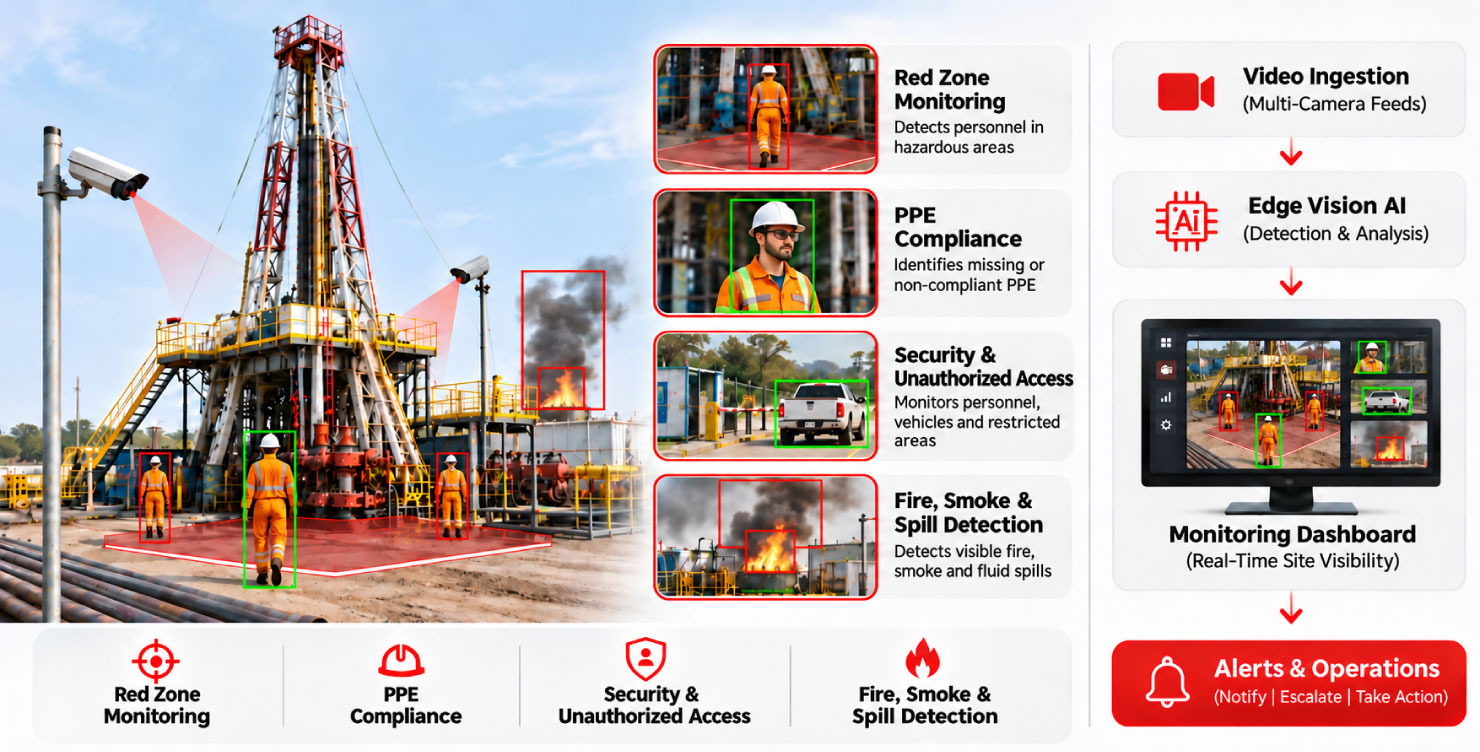
Red Zone Monitoring Around Rig Equipment
Rig floors and pipe-handling areas contain hazardous zones where personnel may be exposed to suspended loads and moving equipment.
Red Zone Monitoring using Computer Vision can identify personnel entering predefined hazardous areas and generate alerts for designated operators.
During pipe-handling activities, for example, a camera monitoring an established exclusion zone can detect a person entering the configured area. The system can notify the responsible operator for assessment and action under site procedures.
Effective monitoring requires clearly defined boundaries, suitable camera coverage, and rules aligned with rig-specific activities.
Worker Safety and PPE Compliance
Drilling personnel require protective equipment appropriate to their assigned activities and site safety procedures.
Computer Vision for PPE Compliance Monitoring supports automated identification of specified visible safety violations across industrial worksites.
At drilling locations, AI PPE Detection can identify missing hard hats or high-visibility clothing where camera positioning, lighting, and image quality permit accurate detection.
These observations can help HSE teams review recurring violations, identify locations requiring additional safety attention, and support compliance documentation.
Fire, Smoke, and Visible Spill Detection
Drilling sites include equipment, piping, tanks, and fluid-handling systems where developing incidents require attention.
Fire and Smoke Detection using Computer Vision can identify visible signs of fire or smoke through appropriately positioned cameras.
Similarly, Oil Spill Detection using Visual AI can support monitoring of certain visible fluid releases, depending on lighting, surface conditions, and camera coverage.
These applications complement dedicated gas detectors, fire protection systems, equipment inspections, and process safety instrumentation.
Security and Unauthorized Access Monitoring
Remote drilling locations involve contractor movement, service vehicles, valuable equipment, and controlled access points.
Oil and Gas Video Surveillance supported by Vision AI can identify configured access violations, monitor restricted-area movement, and flag defined security events.
Vehicle monitoring and access verification can be evaluated according to site security requirements, available infrastructure, and applicable privacy policies.
How Does Vision AI Support Real-Time Rig Monitoring?
Industrial Video Analytics processes camera feeds to identify predefined objects, activities, and operating conditions.
At an onshore drilling rig, cameras capture designated work areas while Vision AI models analyze the images for configured events. Relevant detections can be routed to an operator dashboard or approved notification workflow for investigation and response.
Edge AI processing can support local video analysis at remote drilling sites where connectivity is limited. Where suitable interfaces exist, monitoring information can also contribute to incident reporting and centralized operational dashboards.
What Should Drilling Operators Evaluate Before Deployment?
Enterprise deployment requires defined monitoring priorities and measurable acceptance criteria.
- Camera suitability: Assess existing cameras for resolution, coverage, lighting, dust, vibration, weather exposure, and visual obstructions.
- Detection performance: Define acceptable missed-event rates, false alerts, processing latency, and system availability. Validate performance under representative operating conditions.
- Operational integration: Establish alert recipients, escalation responsibilities, incident documentation, and integration requirements. Any connection to equipment shutdown functions requires separate engineering and safety validation.
- Data governance: Define video access permissions, retention policies, cybersecurity controls, and incident evidence handling.
- Multi-rig scalability: For organizations managing multiple drilling locations, assess centralized visibility, consistent monitoring standards, and site-specific configurations.
How ImageVision.ai Supports Onshore Oil and Gas Operations
ImageVision.ai provides camera-based AI capabilities for industrial safety, security, and operational monitoring. Its broader Computer Vision solutions for the Oil and Gas industry address applications including worker safety, hazardous-area monitoring, fire and smoke detection, vehicle tracking, and visual leak detection.
For onshore drilling environments, solution evaluation considers existing camera infrastructure, operational conditions, safety priorities, and integration with established workflows.
A site-specific feasibility assessment helps identify suitable monitoring applications, define performance requirements, and establish measurable acceptance criteria before wider deployment.
Strengthen Safety Monitoring Across Onshore Drilling Operations
Vision AI provides additional operational visibility across hazardous work areas, supporting the identification and review of predefined safety events.
Talk to Our Vision AI Expert to evaluate monitoring opportunities for your onshore drilling operations.