

Discovering the Best Enterprise Computer Vision Development Services for Your Business
Generate a quick summary


Enterprise Computer Vision has progressed from isolated proof of concept to production deployments. Manufacturers use it to detect defects, logistics teams track goods and vehicles, healthcare organizations improve visual workflows, and infrastructure operators monitor safety and compliance.
The central business challenge is determining whether the complete system can perform accurately, securely, and consistently across real operating conditions.
The best enterprise Computer Vision development services connect AI models with cameras, Edge AI devices, enterprise systems, human workflows, and measurable outcomes. Selecting the right partner therefore requires a broader assessment than comparing model accuracy or development costs.
What Are Enterprise Computer Vision Development Services?
Enterprise Computer Vision development services cover the design, development, deployment, integration, and ongoing management of software that interprets images and video at an enterprise scale.
The scope may include data assessment, camera planning, AI model development, application engineering, Edge AI or Cloud AI deployment, dashboards, alerts, APIs, governance, and performance monitoring.
A production-grade solution should convert visual events into operational action. For example, detecting missing personal protective equipment provides limited value if the result cannot trigger the correct alert, create an auditable record, or connect with an existing safety process.
Start With the Business Outcome
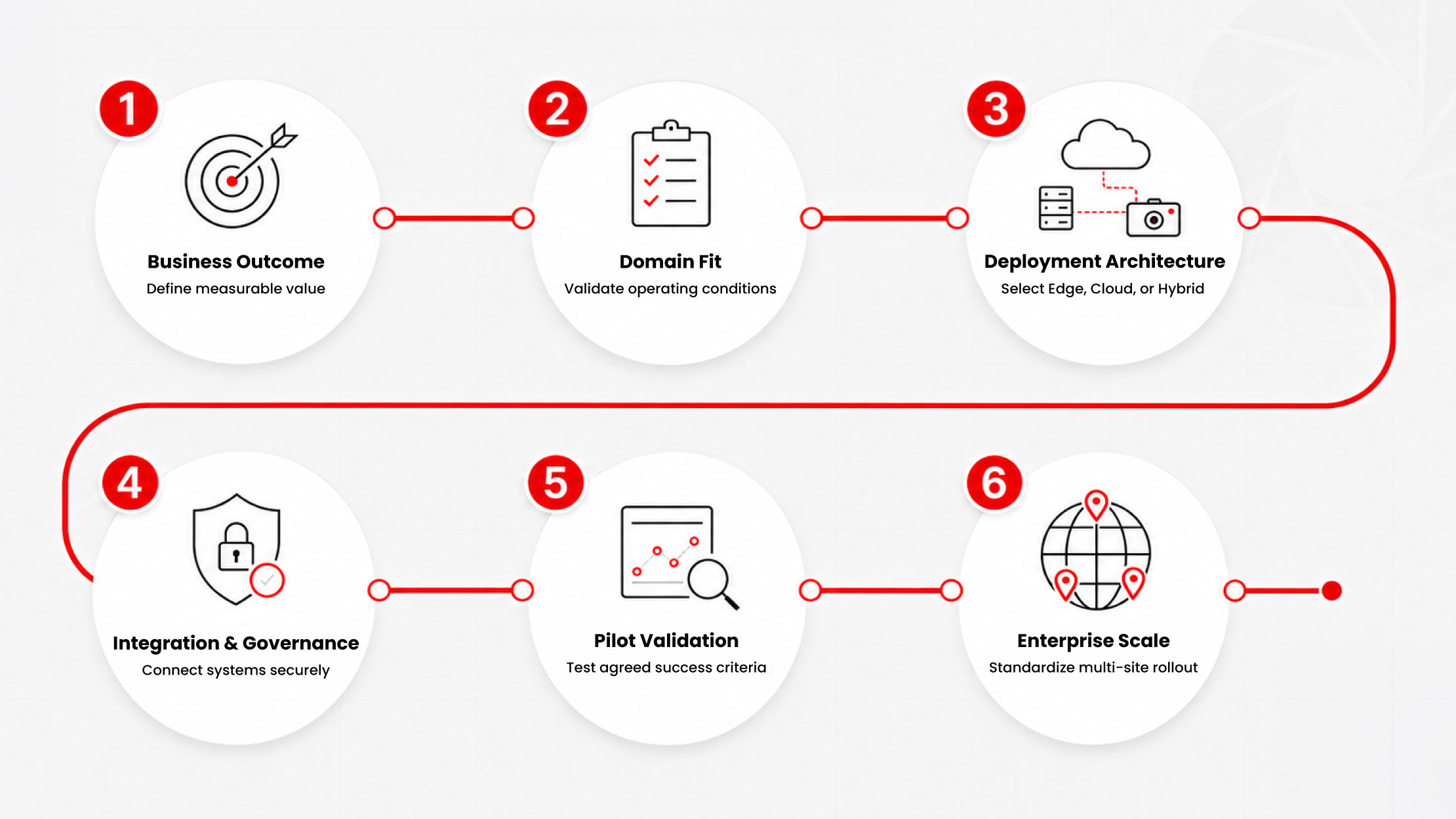
Computer Vision initiatives deliver stronger value when each use case begins with a clearly defined operational problem. Organizations should establish the event to be detected, the decision it supports, the acceptable response time, and the metric that will demonstrate value.
Common objectives include reducing inspection escapes, preventing safety incidents, confirming assembly steps, tracking inventory, automating counts, and improving compliance.
Baseline performance and target outcomes should be defined before development begins. Relevant measures may include detection precision, false-accept and false-reject rates, alert latency, inspection cycle time, rework, incident frequency, downtime, or labor hours saved.
Connecting technical performance with operational metrics keeps the initiative aligned with measurable business value throughout the deployment.
Evaluate Domain and Deployment Expertise
A capable Computer Vision development company should understand both AI engineering and the physical operating environment.
Lighting conditions, camera angles, vibration, dust, motion blur, occlusion, product variation, production speed, and network constraints can affect field performance. The provider should explain how these variables will be assessed and how performance will be validated at the deployment site rather than only against a laboratory dataset.
Deployment architecture matters just as much as AI model design.
Edge AI supports low latency, local operation, reduced bandwidth usage, and tighter control of video data. Cloud AI supports centralized computing, AI model management, and cross-site analytics. A Hybrid AI Architecture can combine immediate local inference with centralized reporting, governance, and AI model updates.
The appropriate architecture depends on response time, bandwidth, privacy, connectivity, availability, infrastructure, and expansion requirements.
Look Beyond a Single AI Model
Custom Computer Vision solutions require a production layer around the AI model. Enterprise buyers should assess whether a provider can support device management, video-stream handling, event rules, role-based access, dashboards, audit trails, system health monitoring, AI model versioning, and integration APIs.
These platform capabilities become increasingly important when a deployment expands from one camera or use case to multiple facilities. Centralized management helps organizations maintain consistent configurations, visibility, governance, and performance across locations.
Integration should also be addressed during solution design. Vision AI may need to exchange information with Manufacturing Execution Systems, Warehouse Management Systems, Enterprise Resource Planning platforms, Video Management Systems, maintenance applications, access-control systems, or Business Intelligence tools.
The provider should present a clear integration plan covering data flows, system ownership, alert routing, access controls, and failure-handling procedures.
Assess Security, Privacy, and Governance
Enterprise video data can contain sensitive operational, employee, customer, or patient information. A provider should define how video and metadata will be collected, processed, encrypted, retained, accessed, and deleted.
The assessment should cover authentication, authorization, audit logging, tenant separation, secure software updates, vulnerability management, and data-retention controls.
Governance must also cover AI model behavior. Enterprises should establish who approves AI models for production, how performance drift will be identified, when human review is required, how model versions will be managed, and how incidents will be investigated.
Certifications provide evidence of established management practices and should be considered alongside a detailed review of the proposed architecture and controls. ImageVision.ai holds ISO/IEC 27001:2022 and ISO 9001:2015 certifications.
Evaluate the Path from Pilot to Enterprise Scale
When selecting enterprise Computer Vision development services, assess how the provider plans to move the solution from feasibility to pilot, production, and multi-site expansion.
During feasibility, the provider should evaluate data quality, technical constraints, deployment conditions, and expected business value. The pilot should validate agreed success criteria in a representative operating environment.
Production planning should cover security, enterprise integration, performance monitoring, technical support, and operational ownership. The expansion phase should establish a standardized approach for deploying the solution across additional sites and use cases.
The evaluation should also include a transparent total cost of ownership covering cameras, Edge AI hardware, Cloud AI infrastructure, integration, data labeling, AI model updates, technical support, and network requirements.
Addressing these components early helps enterprises plan investments accurately and build a scalable foundation for long-term Vision AI deployment.
Questions to Ask a Computer Vision Services Provider
Use these questions when evaluating potential providers.
- Which comparable Computer Vision use cases have reached production?
- How will success be measured against the operational baseline?
- How will changing environments and AI model drift be managed?
- Which Edge AI, Cloud AI, and Hybrid AI architectures are supported?
- How will the solution integrate with existing enterprise systems?
- Which security controls and governance processes are included?
- How will cameras, AI models, applications, and infrastructure be monitored?
- What is the proposed roadmap from pilot to multi-site deployment?
- Which support model and service levels apply after production launch?
Responses should include technical evidence, implementation responsibilities, measurable acceptance criteria, and a clear operating model.
Why Consider ImageVision.ai?
ImageVision.ai provides an Enterprise Vision AI Platform and Computer Vision development services for safety, quality inspection, compliance, and operational performance.
Solutions can be deployed across Edge AI, Cloud AI, and Hybrid AI environments and integrated with existing enterprise systems and video infrastructure.
ImageVision.ai brings AI models, operational workflows, enterprise integration, performance monitoring, and deployment management into one framework. This enables organizations to scale focused use cases into managed Vision AI capabilities across sites and operations.
The platform supports enterprises across manufacturing, logistics, healthcare, energy, transportation, retail, and smart infrastructure.
Build a Scalable Enterprise Vision AI Foundation
Effective enterprise Computer Vision development services combine accurate detection with security, integration, monitoring, and operational workflows. The result is a measurable system designed to perform under real operating conditions and expand across sites without adding unnecessary complexity.
ImageVision.ai helps enterprises evaluate use cases, design deployment architecture, implement Vision AI, and connect visual insights with existing operational workflows.
Schedule a consultation with us to identify where Enterprise Computer Vision can deliver measurable value across operations.