

Counterfeit Product Detection Using Deep Learning for Brand Protection
Generate a quick summary


For any brand, trust begins before a customer opens the product. It starts with the packaging they know, the label they trust, the guarantee that what they’re buying is the real deal. And it’s getting harder and harder to maintain that trust.
Counterfeit products are no longer easily identifiable as copies with glaring defects. Many fake products now resemble original packaging, labels, logos, barcodes, QR codes, colors, bottle shapes and security markings so closely that they are difficult to distinguish by manual inspection alone in retail outlets, warehouses, pharmacies, distribution centers and e-commerce operations.
Traditional product verification methods such as barcodes, QR codes, RFID tags, packaging seals, and manual audits still have their role to play. But counterfeiters have become better at copying those elements as well. A barcode may scan correctly. A label may appear legitimate. A seal may look authentic. Yet the product itself may still be counterfeit.
This is where counterfeit product detection using Deep Learning is becoming an important part of modern brand protection strategies.
The Real Cost of Counterfeit Products
Counterfeit products can do much more than affect revenue. They can affect customer confidence, operational efficiency, compliance readiness, distributor relationships and the overall brand reputation.
When a counterfeit product makes it to a customer, the brand is typically held responsible, regardless of where in the supply chain the counterfeit originated. Customers may complain about product failure, package inconsistencies, safety issues, or poor product quality without ever knowing the product was not real.
The results can include:
- Customer complaints and refund requests
- Negative product reviews
- Compliance and regulatory risks
- Retail disputes
- Revenue leakage
- Distributor conflicts
- Loss of consumer confidence
In industries such as pharmaceuticals, food and beverages, cosmetics, electronics, automotive parts, and luxury goods, counterfeit products can create serious safety concerns.
For many businesses, the biggest challenge is not that counterfeit products exist. The challenge is identifying them before they reach customers.
The problem becomes even harder because modern counterfeit products are designed to visually resemble genuine products as closely as possible.
Why It’s Harder to Spot Counterfeit Product
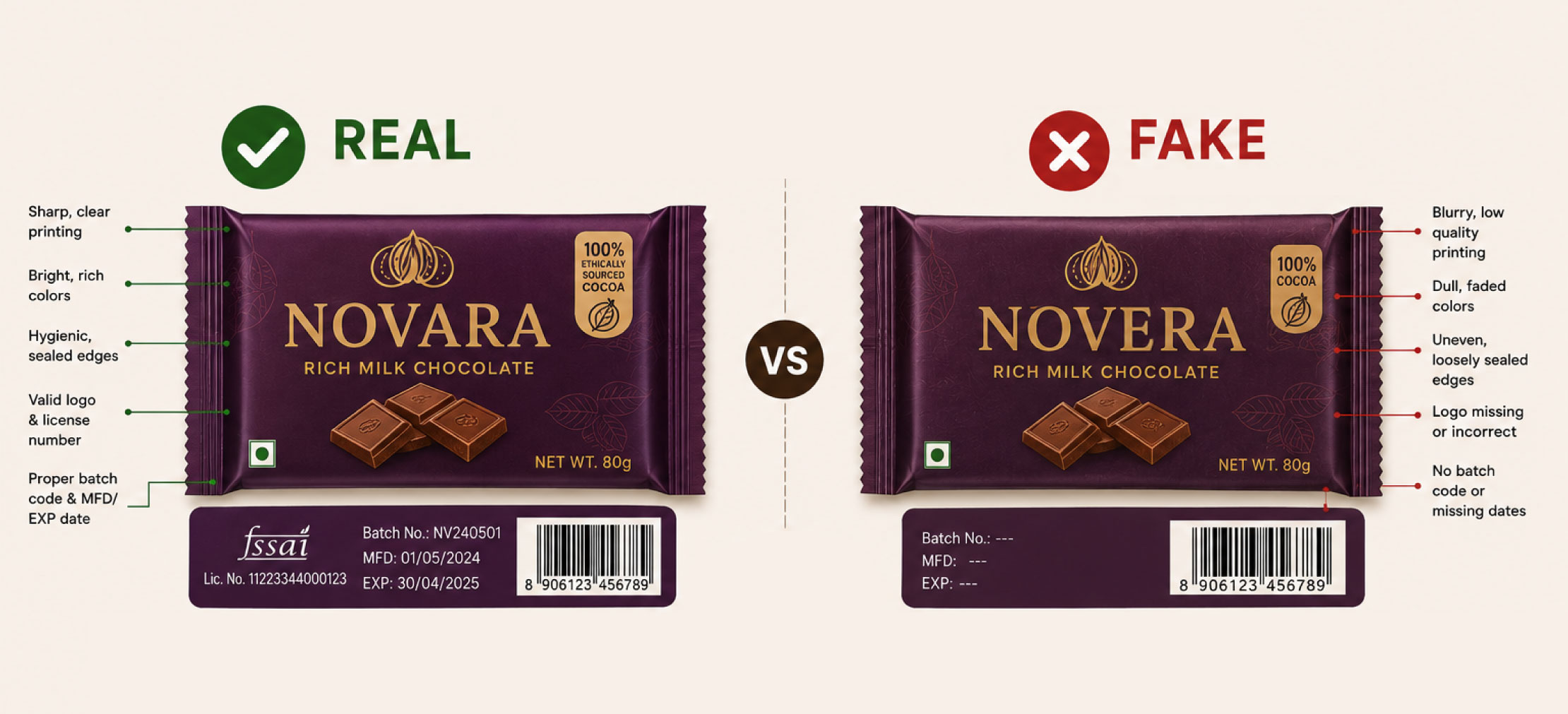
Today’s counterfeiters know packaging design and what consumers expect. They mimic the visual appearance that consumers expect with legitimate products. A fake product can look like the real one at first glance. The logo may look correct. The label may seem to be accurate. The packaging may look like the original product. The differences are usually in the finer visual details like logo alignment, print sharpness, label positioning, color consistency, barcode spacing, packaging finish, surface texture, text or product shape variations.
In a fast-moving retail environment, staff may also find it difficult to consistently identify subtle counterfeit indicators across large volumes of products. When inspecting products manually, a warehouse team that inspects thousands of incoming products a day may miss small differences in label placement or texture of packaging.
Manual inspection is still important, but it is highly dependent on human attention, product familiarity, lighting conditions, inspection speed, and operational workload. Consistency of inspection in high-volume retail and supply chain environments becomes more challenging.
Disadvantages of Traditional Product Verification
Most organizations have systems to verify products and track their origin. Some common systems include barcodes, QR codes, RFID tags, batch numbers, seals on packaging, supply chain tracking systems and manual quality audits. These methods remain useful, but they do not fully address appearance-level counterfeit risks.
A code can be copied. A seal can be replicated. A label can be reproduced. Supply chain records may appear valid even when counterfeit products enter the channel. The key limitation is that many traditional systems validate the data surrounding the product rather than the visual appearance of the product itself.
Today’s businesses need enhanced visual verification capabilities, along with the traditional tracking and authentication methods.
How Image-Based Counterfeit Detection Works
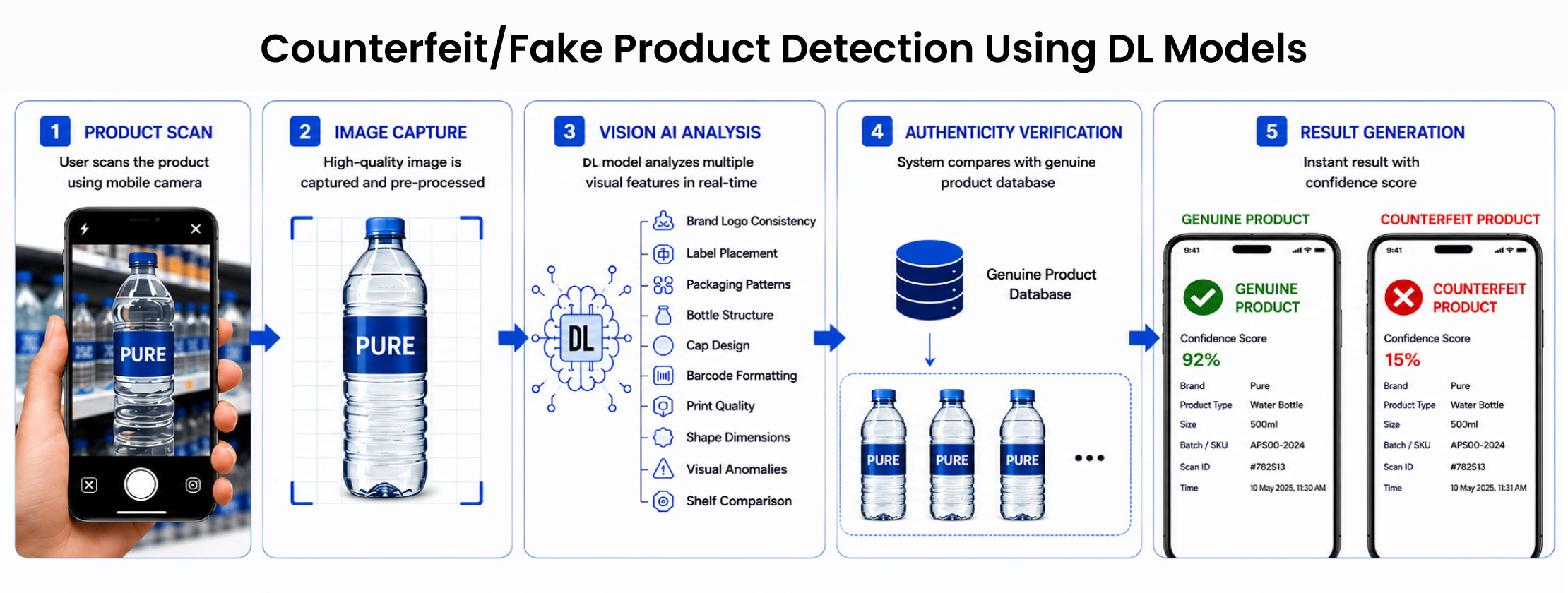
It all starts with a product image captured by cameras, inspection systems, mobile devices, or uploaded product photos. The system assesses image quality, extracts visual product attributes, and compares them with approved reference images or learned product standards.
The system can classify products as visually authentic or potentially counterfeit based on packaging and appearance inconsistencies.
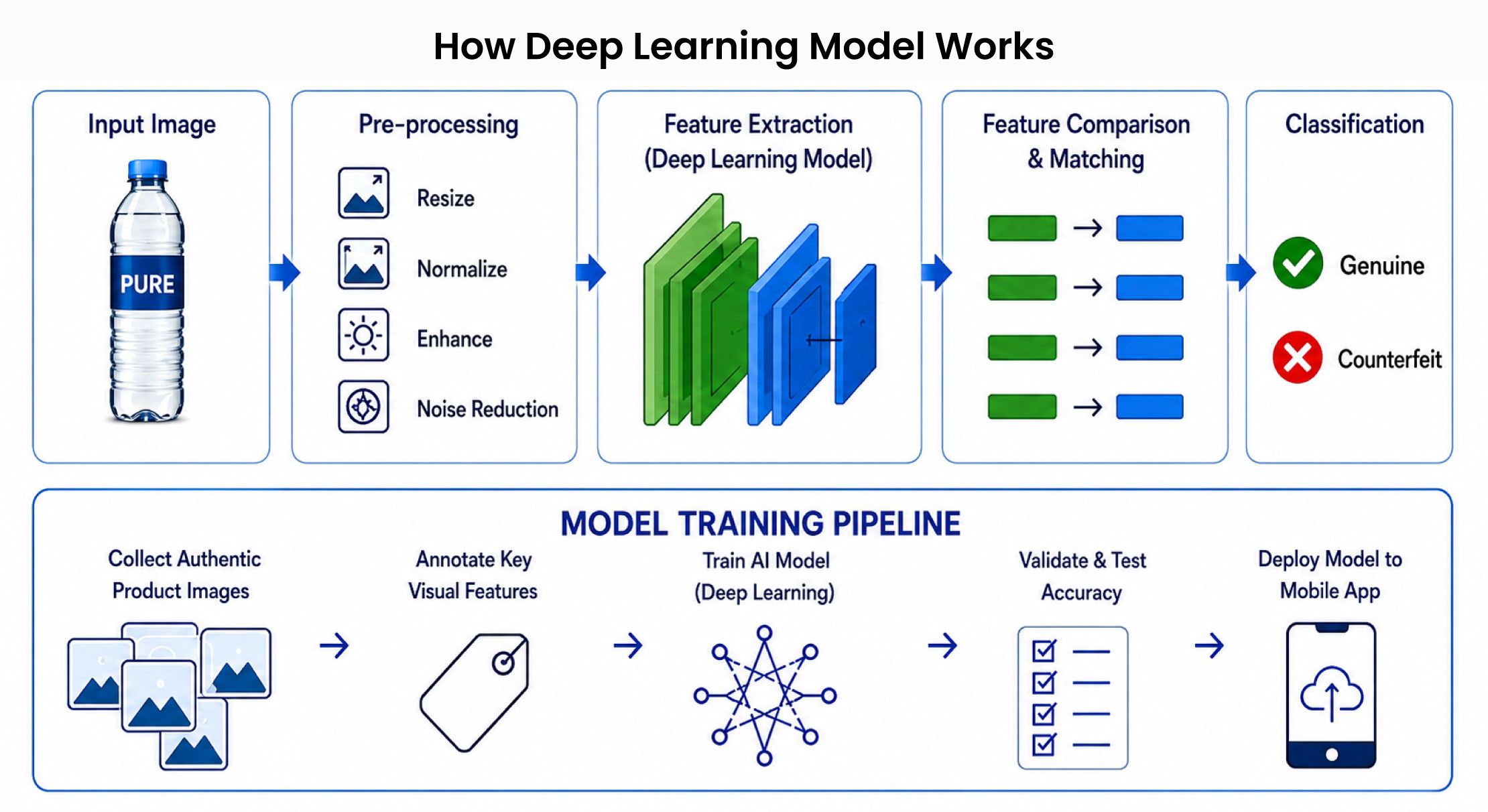
This allows businesses to standardize visual inspection processes across locations where manual verification may vary between teams and environments. Businesses can improve inspection workflow with counterfeit product identification through Computer Vision across:
- Retail shelf inspections
- Warehouse receiving operations
- Distributor verification
- Manufacturing quality control
- E-commerce return validation
- Pharmacy product inspections
- Supply chain audits
Benefits of AI Based Counterfeit Detection
- Faster inspection workflows
- Consistent verification across locations
- Reduced counterfeit leakage
- Improved product authentication at scale
- Better supply chain visibility
- Reduced return fraud risks
Conclusion
Any industry that is concerned with customer trust, safety, compliance, or revenue, where product authenticity is relevant, needs counterfeit product identification.
Counterfeit risks are particularly prevalent in the industries of pharmaceuticals, food and beverages, cosmetics and personal care, consumer packaged goods, electronics, automotive spare parts, luxury goods, retail chains, distribution networks and e-commerce operations.
Given the challenge of detecting counterfeit products through manual inspection alone, companies need more robust visual verification systems that are scalable for retail, warehouse, manufacturing and supply chain environments.
Fake product identification detection allows companies to scale product appearance verification, detect suspicious differences in packaging, and create more robust product authentication workflows to help prevent counterfeit products from reaching the customer.
Protect your brand before counterfeit products reach your customers ImageVision.ai. Contact us to learn how fake product detection using Computer Vision can support faster product authentication and stronger visual inspection workflows across your business.