

Vial Surface Defect Detection with Vision AI for Pharmaceutical Quality Control
Generate a quick summary


A glass vial rejected before filling represents a different financial loss from one rejected after it contains a pharmaceutical formulation. By that stage, manufacturers may have incurred additional drug product, processing, and quality-control costs.
For pharmaceutical manufacturers, identifying unacceptable containers at the appropriate production stage is an important consideration for product quality, material utilization, and operating efficiency.
Vial Surface Defect Detection with Vision AI offers a potential application of Computer Vision for identifying specified visible glass defects, including cracks, chips, and scratches. Its business value depends on inspection performance, clearly defined quality criteria, and compatibility with manufacturing operations.
The Financial and Quality Impact of Glass Vial Defects
Glass vials undergo several handling and processing stages, including washing, filling, stoppering, capping, and transfer between equipment. Mechanical contact during these operations can contribute to scratches or other forms of glass damage.
A study published in the European Journal of Pharmaceutical Sciences investigated glass damage during sterile drug manufacturing. Researchers examined mechanical stresses within an industrial filling line, identified contributing equipment components, and implemented corrective adjustments.
The findings highlight the importance of investigating manufacturing conditions associated with recurring glass damage.
For manufacturing leaders, inspection placement influences the financial consequences of rejection. Identifying an unacceptable empty vial before filling may prevent additional processing costs, while inspection at later stages may identify damage introduced during manufacturing.
The appropriate inspection strategy depends on where defects occur, their quality significance, and the operational impact of rejecting affected containers.
How Vision AI Supports Glass Vial Defect Detection
Glass Vial Defect Detection using Computer Vision requires an imaging approach suited to the container’s optical characteristics and the defects being examined.
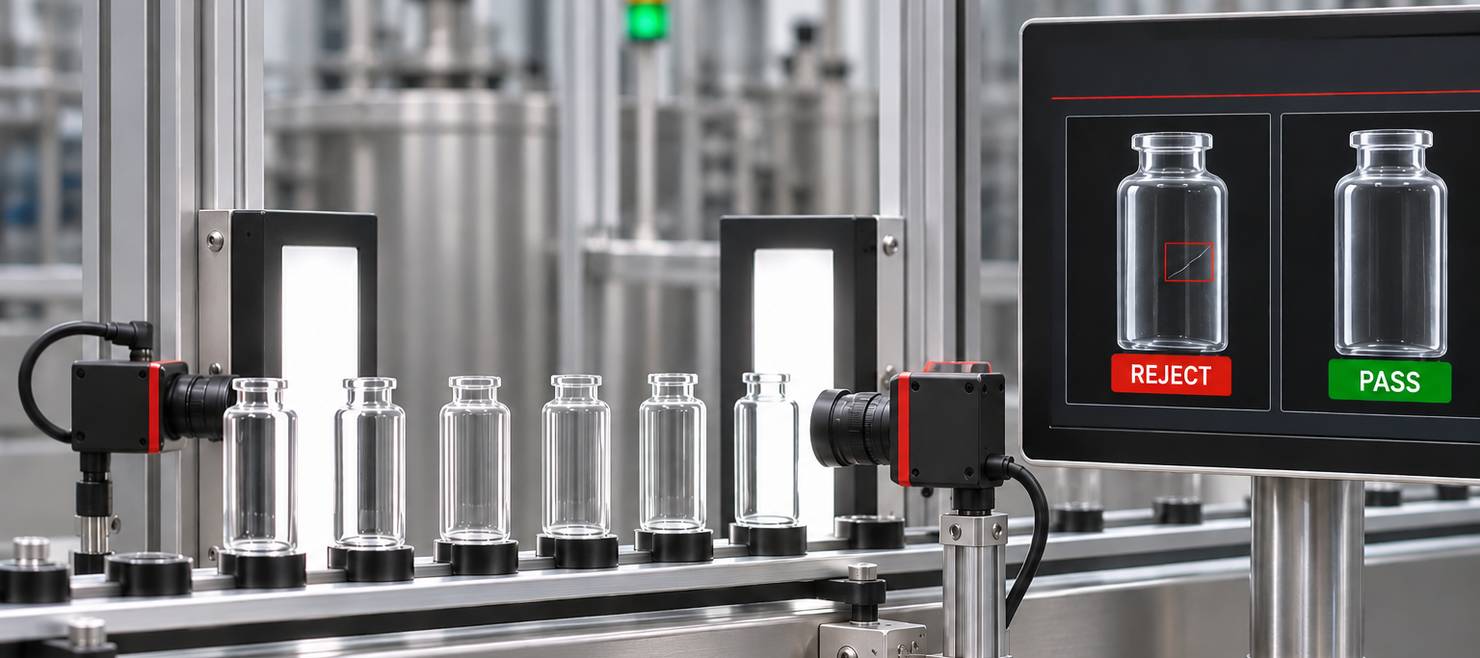
Industrial cameras and controlled illumination can be evaluated for examining specified external surfaces, including the vial body, shoulder, neck, heel, and bottom.
Computer Vision models can then be assessed for identifying visible abnormalities against established inspection criteria. Several technical factors influence the inspection configuration.
- Defect Characteristics: Cracks, chips, and scratches vary in size, orientation, location, and visual appearance.
- Container Properties: Transparent and amber glass have different optical characteristics. Curvature and reflections also affect image acquisition.
- Surface Coverage: Camera positioning, illumination, and container orientation influence the visibility of the inspected regions.
- Production Conditions: Line speed, container movement, and handling arrangements affect image capture and inspection timing.
These factors determine the imaging requirements and provide a basis for evaluating defect detection performance under representative production conditions.
Improving Inspection Decisions and Managing False Rejection
Identifying a visible surface abnormality is one part of Pharmaceutical Vial Inspection. Determining whether the container meets approved quality specifications is equally important.
A superficial cosmetic variation and a potentially significant glass defect may require different quality decisions. This distinction influences two important inspection measures.
- Defect Detection Performance: Indicates how effectively an inspection approach identifies specified unacceptable defects under defined evaluation conditions.
- False Rejection Rate: Measures the proportion of acceptable containers incorrectly classified as unacceptable.
Missed unacceptable defects can create quality risks, while excessive false rejection increases material losses and inspection workload.
Manufacturers should evaluate representative acceptable, defective, and borderline samples across relevant vial formats and operating conditions.
Documented acceptance criteria should define target defects, inspection coverage, evaluation methods, and application-specific performance thresholds.
Integrating Vial Surface Inspection into Pharmaceutical Manufacturing
Vial Surface Inspection must account for the practical requirements of the manufacturing process.
Production speed, container spacing, equipment layout, available installation space, and control interfaces influence how an inspection arrangement can be implemented.
Where inspection decisions are intended to support automated rejection, the proposed system must be evaluated for container tracking and coordination with downstream handling equipment.
Inspection images and classification records may support quality investigations when appropriate data capture and retention are included in the system design.
Any production implementation must also address applicable qualification, validation, change-control, and data-integrity requirements.
These considerations influence implementation complexity and the ability of the proposed inspection method to support existing pharmaceutical quality procedures.
Measuring the Business Value of Pharmaceutical Quality Inspection
The commercial justification for Computer Vision inspection should begin with existing manufacturing performance and the financial impact of current quality challenges.
Four operational indicators are particularly relevant.
- Rejected Container Costs: The financial impact of rejection depends on the production stage, container value, drug product value, and processing already completed.
- False Rejection Losses: Incorrect rejection of acceptable containers can contribute to avoidable material waste and additional review effort.
- Inspection Workload: Manual inspection, defect review, and quality investigations require operational resources that should be considered when evaluating inspection methods.
- Recurring Defect Patterns: Inspection findings may help quality and engineering teams investigate damage associated with particular handling operations, equipment locations, or production periods.
Together, these measures help manufacturers establish the financial impact of their existing inspection process.
The business case should compare potential improvements with implementation costs, ongoing operating expenses, and measurable operational requirements. Expected savings should be supported by application-specific testing and relevant production data.
Establishing Inspection Requirements Before Investment
An effective inspection project begins with a clear understanding of the manufacturing problem and the quality decisions the proposed system must support.
The assessment should establish target defect categories, vial specifications, inspection locations, representative samples, production speeds, and integration requirements.
For enterprise pharmaceutical manufacturers, three considerations should guide the investment decision.
- Inspection Performance: Can the proposed approach identify specified defects while maintaining acceptable false rejection levels?
- Operational Compatibility: Can the inspection configuration meet production throughput, equipment integration, and established quality requirements?
- Business Value: Does the potential operational improvement justify implementation and ongoing costs?
These questions help manufacturers evaluate technical suitability and investment priorities using defined criteria rather than relying solely on demonstration results.
Evaluating Vision AI for Pharmaceutical Vial Inspection
An enterprise Vision AI approach connects visual defect analysis with manufacturing processes, quality requirements, and operational decision-making.
The application of Vision AI in pharmaceutical quality control extends across product and packaging inspection, with requirements determined by the material, process, and intended quality decision.
For glass vial surface inspection, evaluating technical feasibility alongside the existing cost of quality provides a basis for determining whether further investment is warranted.
Discuss your vial formats, surface defect challenges, production requirements, and inspection feasibility. Contact Us