

Scaling Edge Vision AI for Enterprise Operations
Generate a quick summary


An Edge Vision AI deployment at one facility establishes whether an application can perform under that site’s conditions. Expanding it across multiple locations requires evidence that operational value, performance, and ownership costs remain acceptable as those conditions change.
Lighting, camera placement, production speeds, product variations, and network availability can differ between facilities. Each difference can affect the effort required to reproduce a successful deployment.
The investment decision rests on repeatability. What can be standardized? Where is local adaptation necessary? What evidence justifies committing capital to the next group of sites?
Establish Business Case for Enterprise Edge AI
Edge Vision AI analyzes images and video close to where they are captured. As a visual application of edge AI, it can support local decisions while reducing dependence on continuous video transmission to remote systems.
Enterprise Edge AI should begin with a measurable operational problem. Inspection applications may target defect escapes, unnecessary rejection, or manual review. Counting and verification applications may address discrepancies, reconciliation effort, or shipment errors.
Record the existing baseline before evaluating improvement.
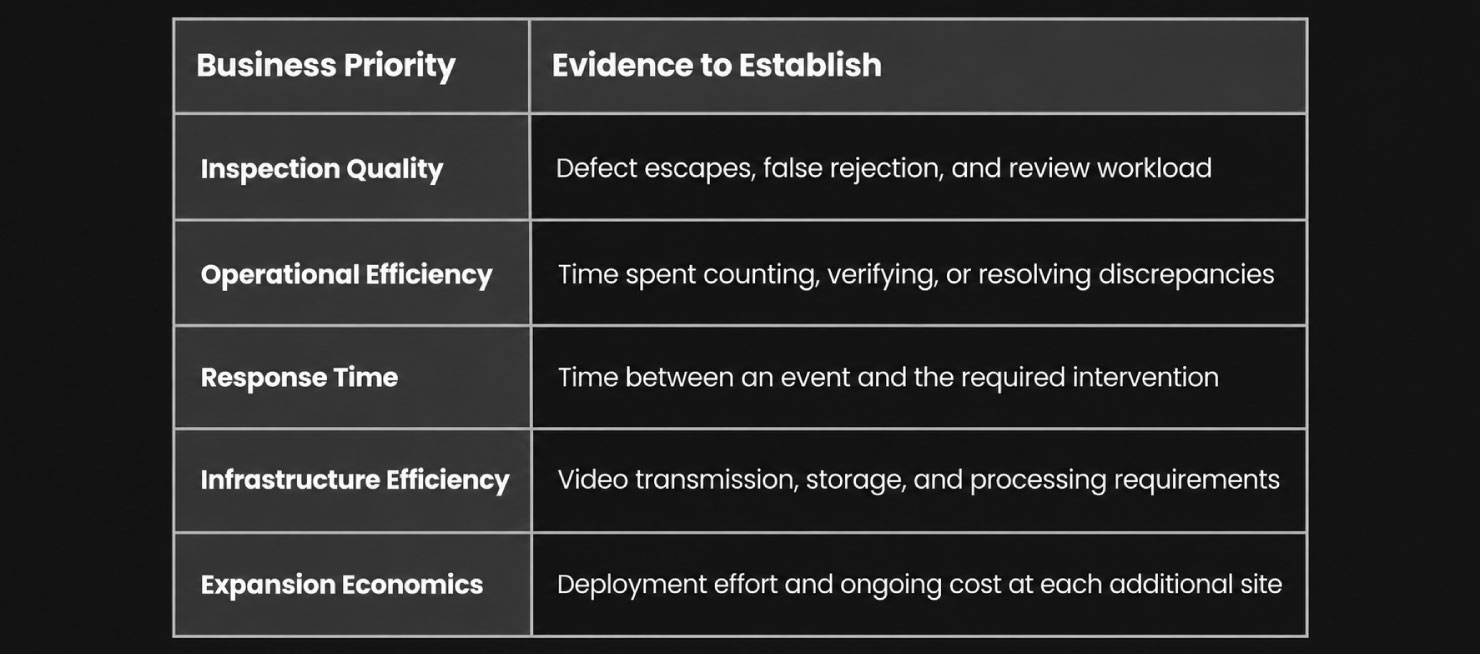
Reduced bandwidth consumption is one component of the business case. Equipment, software, integration, maintenance, and performance review also contribute to ownership costs.
Separate benefits demonstrated during validation from benefits that still depend on assumptions.
Align Edge AI Infrastructure with Site Requirements
Edge AI Infrastructure should reflect the application’s response window, image requirements, and operating environment.
Processing may run on a camera, industrial computer, or server within the facility. Central systems can support management, reporting, and analysis across locations. AWS guidance on local inference describes how local processing can operate alongside cloud capabilities.
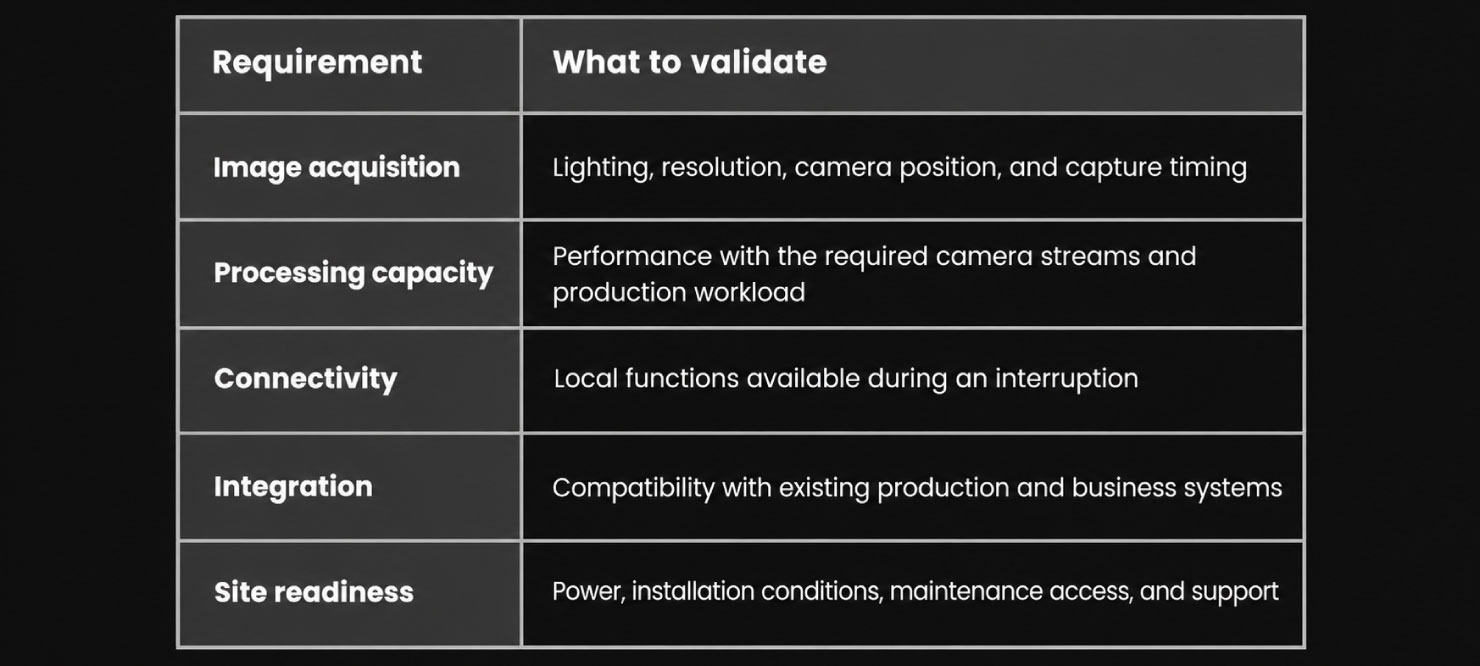
Existing cameras should be assessed against the intended task. A view suitable for general monitoring may lack the detail needed to identify a small packaging defect.
Offline operation also needs explicit testing. Local inference may continue while remote dashboards, notifications, or management functions become unavailable.
Connect Edge Video Analytics to Operational Action
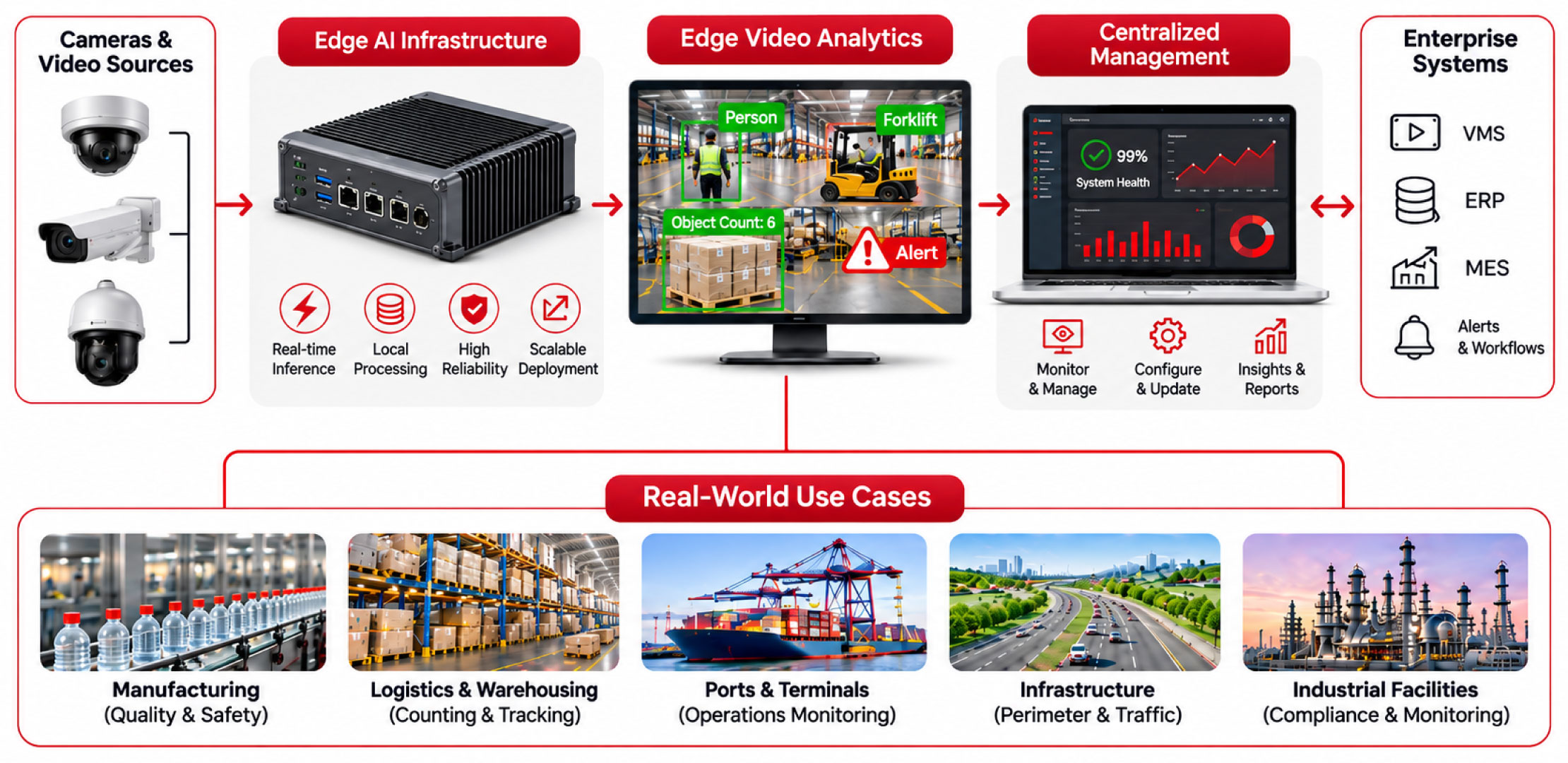
Edge Video Analytics creates value when a detected event leads to an appropriate response.
In a packaging inspection workflow, a suspected defect might trigger operator review, a rejection mechanism, or an exception recorded in a quality system. The response depends on the process and the consequences of an error.
Define who receives the result, what action is expected, and how resolution is recorded. Where integration is required, validate the interfaces and permissions needed to exchange information with existing systems.
False alerts can increase review workload. Missed events can leave the original operational problem unresolved. Both should be evaluated alongside processing speed.
For packaging inspection applications, acceptance should cover the complete sequence from image capture to production action.
Establish Edge AI Device Management Before Expansion
Edge AI Device Management determines how distributed deployments will be maintained after installation.
Central teams need visibility into camera availability, interrupted applications, equipment utilization, software versions, and configuration changes. They also need procedures for resolving issues that require local intervention.
Equipment availability and detection performance require separate oversight. A server may remain operational even when a camera has moved or a lighting change has affected image quality.
The operating agreement should assign responsibility for monitoring, troubleshooting, equipment replacement, and performance review. Updates should be tested on a limited deployment before wider release, with a documented recovery procedure.
Standardization should allow controlled site differences. Camera settings and inspection thresholds may vary, while approval, documentation, and maintenance practices remain consistent.
Define Governance and Operational Ownership
Accountability must extend across infrastructure, application performance, and operational response.
IT teams may manage computing and cybersecurity. Operational technology teams may oversee production interfaces. Operations and quality teams should approve acceptance criteria and exception handling.
Local processing still requires access controls, protected communications, software maintenance, and clear video retention policies. NIST guidance for operational technology security provides a reference for applying security controls within operational environments. Document which information leaves each facility, who can access it, and who can authorize system changes.
Gartner’s guidance on operating model alignment connects enterprise AI value with workflows, shared technology capabilities, measurable outcomes, and accountability. These considerations should be reflected in the deployment’s operating agreement.
Validate Production Performance Before Further Investment
A single accuracy percentage provides limited grounds for expansion. Results should reflect relevant operating conditions and the consequences of different errors.
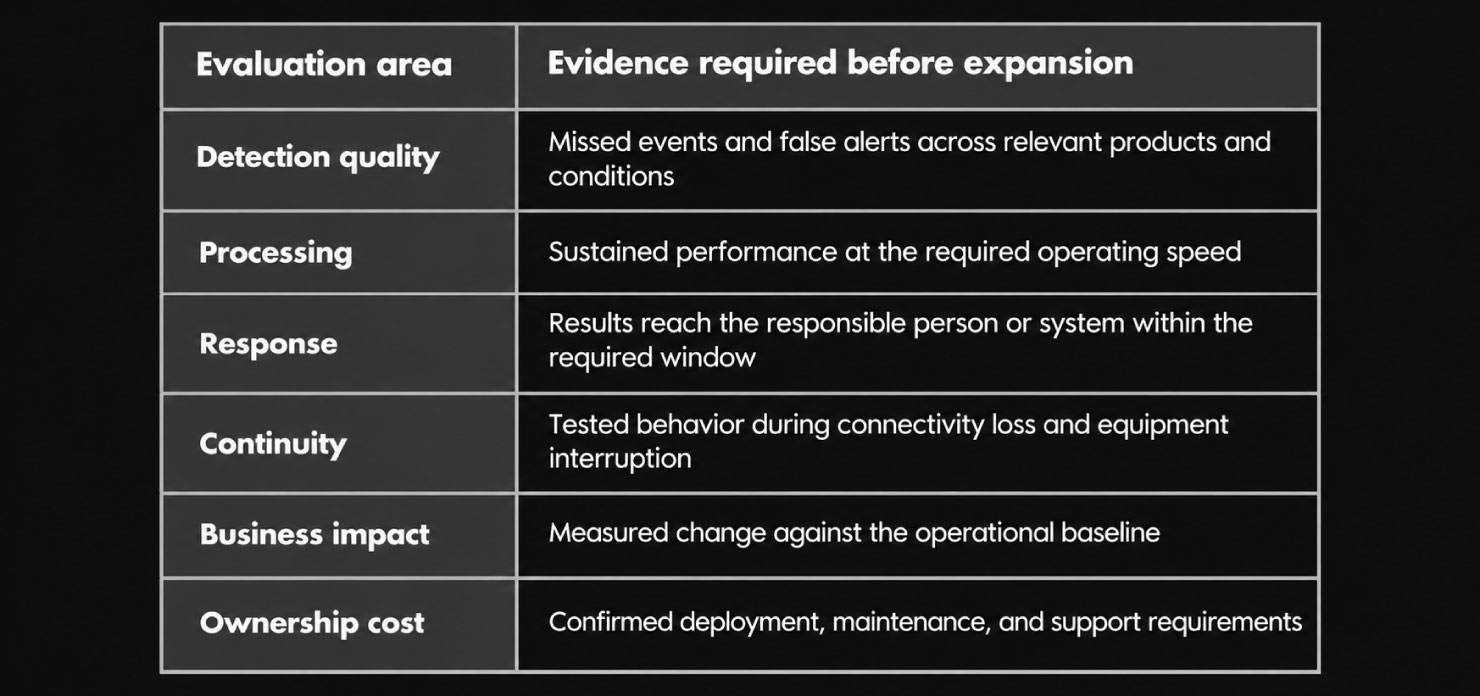
Testing should include representative shifts, lighting conditions, product variations, and exception scenarios. The AI visual inspection evaluation guide covers additional considerations for inspection acceptance.
Expand in controlled stages. Investigate facilities that miss acceptance criteria before repeating the same configuration elsewhere. Reassess performance when products, camera positions, or workflows materially change.
Discuss Your Edge Vision AI Deployment Priorities
A credible expansion plan establishes where the application creates value, what each facility requires, and how performance will be maintained.
Talk to a Vision AI Expert to review your application, existing infrastructure, and acceptance criteria for deployment across multiple facilities.