

Vision AI for Municipal Waste Management in Smart Cities
- Vathslya Yedidi
- March 11, 2026
Municipal solid waste generation is increasing due to population growth, urban expansion, and rising consumption. According to World Bank’s What a Waste 2.0 report, global waste generation exceeds 2 billion tonnes annually and may reach 3.4 billion tonnes by 2050. Municipal governments and waste management operators must maintain sanitation standards, comply with environmental regulations, control operational costs, and improve recycling outcomes simultaneously.
Traditional waste management systems depends on manual inspections, scheduled operations, and labor-intensive sorting processes. These approaches create operational gaps across waste infrastructure, recycling facilities, and public sanitation systems. Contamination in recycling streams, illegal dumping incidents, limited visibility into sanitation conditions, and workplace safety risks remain persistent challenges.
Vision AI for municipal waste management enables cities to introduce visual intelligence into waste operations by analyzing images and video streams to identify waste materials, detect environmental violations, and monitor operational safety conditions. Combining camera-based monitoring with Deep Learning models and analytics platforms, municipalities and waste operators can improve visibility across waste processing facilities and public sanitation infrastructure.
This blog explores how Vision AI for Municipal Waste Management helps cities improve waste operations, recycling efficiency, and safety across waste management systems.
The Municipal Waste Management Lifecycle
Effective municipal waste systems follow a structured lifecycle that ensures safe handling, resource recovery, and regulatory compliance.
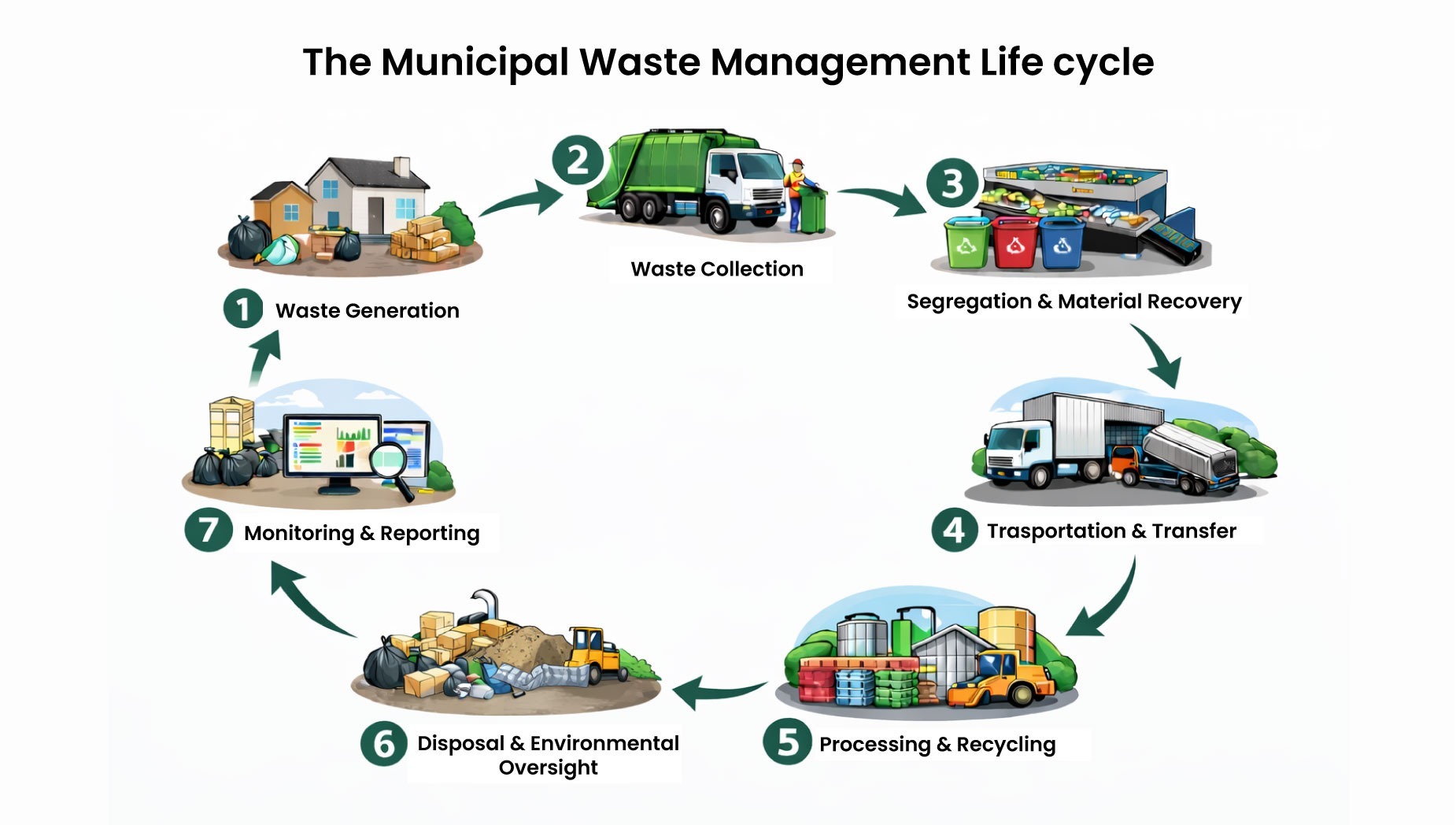
Stage 1 – Waste Generation: Waste is generated from residential neighborhoods, commercial districts, institutions, construction sites, and public spaces. The waste stream typically includes organic waste, plastics, metals, glass, paper, cardboard, textiles, and mixed residual materials.
Stage 2 – Waste Collection: Collection operations include curbside pickup, community container servicing, and commercial dumpster collection. Reliable collection services are essential for maintaining public sanitation.
Stage 3 – Segregation and Material Recovery: Waste is separated into recyclable, organic, and residual categories either at the source or within processing facilities. Contamination in recycling streams reduces recovery efficiency and lowers the value of recyclable materials.
Stage 4 – Transportation and Transfer: Collected waste is transported to transfer stations or to recycling and processing facilities where materials are consolidated for further handling.
Stage 5 – Processing and Recycling: Recyclable materials are sorted and processed for reuse. Organic waste may undergo composting or anaerobic digestion, while residual waste proceeds to landfill or energy recovery facilities.
Stage 6 – Disposal and Environmental Oversight: Final disposal occurs at regulated landfill facilities equipped with environmental safeguards such as liner systems, leachate management, and landfill gas capture mechanisms.
Stage 7 Monitoring and Reporting: Municipalities track recycling rates, contamination levels, complaint response times, and compliance indicators to evaluate system performance.
Operational Gaps in Conventional Waste Systems
Despite structured workflows, municipal waste systems continue to face several operational challenges that affect efficiency, safety, and sanitation management.
- Recycling Stream Contamination: Material recovery facilities receive mixed waste streams that contain non-recyclable materials, food residue, or plastic bags. This contamination reduces the quality of recyclable materials and makes sorting more difficult.
- Illegal Dumping in Unmonitored Areas: Unauthorized waste disposal in vacant lots, roadside areas, and industrial zones remains a persistent issue for many cities. Municipal authorities depend on citizen complaints or periodic inspections to identify dumping incidents.
- Worker Safety Compliance in Waste Facilities: Waste processing plants involve conveyor systems, heavy equipment, and manual handling of waste. Ensuring workers consistently follow safety protocols and wear required protective equipment can be difficult in large facilities.
- Litter Accumulation in Public Spaces: Maintaining cleanliness in streets, parks, and transportation hubs requires continuous monitoring. Municipal sanitation teams depend on manual inspections to identify areas where litter has accumulated.
Layered Automation in Waste Management with Vision AI
Modern waste management systems use Computer Vision to introduce automation and intelligence into operational workflows. Vision AI models analyze images and video streams to identify waste materials, monitor environmental conditions, and improve safety in waste processing facilities.
1. Waste Classification and Automated Sorting Using Vision AI

Material recovery facilities handle large volumes of mixed recyclable waste that must be separated into different material streams. Vision AI cameras installed above conveyor belts capture images of waste moving through conveyor. Deep Learning models classify materials such as plastics, metals, paper, cardboard, and glass in real time. For accurate detection, waste must be spread in a single-layered flow on the conveyor belt so that each item is fully visible to the camera. When waste is dumped in thick piles, materials in the lower layers become occluded and cannot be detected reliably. Automated systems such as robotic arms or air jets then separate the identified materials into the appropriate recycling streams. Waste classification using Deep Learning increases sorting efficiency, reduces contamination in recycling streams, and improves material recovery rates.
2. Illegal Waste Dumping Detection using Computer Vision

Unauthorized waste disposal in public areas, vacant lots, and industrial zones creates environmental and sanitation challenges. Computer Vision systems connected to surveillance cameras can analyze video streams to detect dumping activities. Vision AI models identify suspicious behaviors such as unloading waste or discarding large items in restricted locations. When such incidents are detected, the system records visual evidence that municipalities can use for enforcement and investigation.
3. PPE Detection Using Vision AI for Worker Safety in Waste Facilities

Waste processing plants and recycling facilities involve complex machinery and potentially hazardous environments. PPE detection using Computer Vision systems can monitor worker safety by detecting whether employees are wearing required personal protective equipment such as helmets, gloves, masks, or reflective vests. AI models analyze video feeds from facility cameras and generate alerts when safety violations occur or when workers enter restricted zones without proper protection. PPE Detection in waste processing facilities helps improve workplace safety and supports compliance with occupational safety regulations.
4. Litter Detection using Computer Vision in Public Spaces

Maintaining cleanliness in public areas such as streets, parks, beaches, and transportation hubs is an ongoing challenge for municipal sanitation teams. Computer Vision systems can analyze street-level camera feeds to detect visible litter such as plastic bottles, bags, or packaging materials scattered across public spaces. By identifying sanitation hotspots where litter accumulation occurs, municipalities can prioritize cleanup operations and improve urban cleanliness.
Measurable Outcomes of Vision AI in Waste Management
When deployed within municipal waste systems, Computer Vision applications in waste management deliver measurable operational improvements.
- Improved recycling efficiency through automated waste classification
- Faster identification of illegal dumping incidents
- Improved worker safety in waste processing facilities
- Enhanced monitoring of sanitation conditions in public areas
- Reduced reliance on manual inspections
These capabilities help municipalities manage waste infrastructure more efficiently while supporting environmental sustainability initiatives.
Frequently Asked Questions
1. How does Computer Vision classify waste materials
Computer Vision models analyze images of waste items using Deep Learning algorithms that recognize shapes, textures, and visual patterns associated with different material types.
2. Is AI powered waste sorting suitable for existing recycling facilities
Many automated sorting solutions can integrate with conveyor-based systems in material recovery facilities with minimal infrastructure changes.
3. Can Vision AI system operate in outdoor environments
Yes. Vision AI system can analyze outdoor camera feeds under varying lighting and weather conditions with appropriate model training.
4. What operational benefits do municipalities gain from Vision AI in waste management
Vision AI helps municipalities improve recycling efficiency, detect illegal dumping, monitor sanitation conditions, and enhance worker safety in waste facilities.
5. How does Vision AI help municipalities respond faster to sanitation issues?
Vision AI continuously monitors camera feeds from waste facilities and public areas to detect issues such as illegal dumping or litter accumulation. When detected, the system sends alerts to municipal teams, enabling quicker response and faster cleanup actions.
Conclusion:
Municipal waste management requires coordination across collection infrastructure, recycling facilities, environmental oversight, and safety compliance. Limited visibility and manual monitoring can restrict operational efficiency and delay responses to sanitation issues.
Vision AI for municipal waste management introduces automated monitoring, intelligent material classification, and real-time insights into municipal waste systems. From automated sorting in recycling facilities to detecting illegal dumping and monitoring worker safety, Vision AI enables municipalities to manage waste infrastructure more effectively.
As cities continue investing in smart infrastructure and sustainability initiatives, Computer Vision is becoming an important technology for modern waste management strategies.
To explore how Vision AI can enhance your waste management operations, Connect with us.