
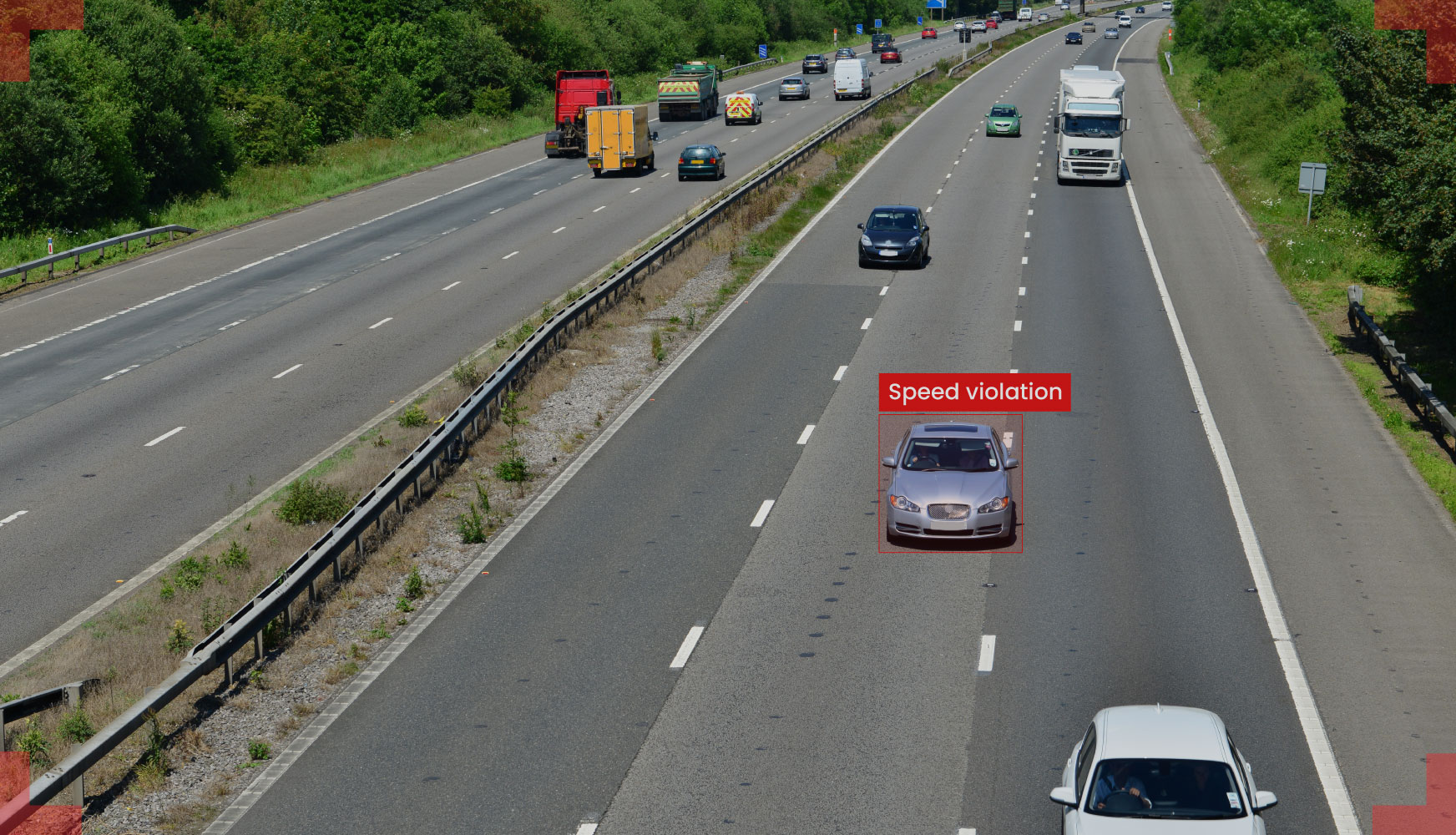
Traffic Monitoring and Surveillance Using Computer Vision for Real-Time Insights
Managing traffic across urban road networks involves ongoing challenges in maintaining visibility, identifying disruptions early, and responding effectively as road conditions change.
Traffic operations teams are required to monitor multiple camera feeds across intersections, highways, and public roads while ensuring timely detection of congestion, violations, and incidents. As traffic patterns shift dynamically based on vehicle density and road usage, maintaining consistent situational awareness becomes increasingly difficult.
Without systems that can continuously interpret road activity, traffic management remains reactive, limiting the ability to respond efficiently.
Traffic monitoring and surveillance using Computer Vision addresses this gap by enabling continuous analysis of live video feeds. Computer Vision for transportation combined with AI video analytics for traffic monitoring, these systems convert video into actionable insights, allowing traffic teams to detect events, track movement, and make informed decisions in real time.
Limitations of Manual Traffic Monitoring in Urban Environments
As traffic networks expand, manual monitoring approaches struggle to scale effectively.
Operators are required to oversee multiple video feeds simultaneously, making it difficult to maintain consistent visibility across locations. This often results in delayed identification of congestion, violations, and road incidents.
Traffic conditions also evolve rapidly. Variations in vehicle flow, driver behavior, and road usage create complexity in interpretation, especially in high-density environments where even small delays can lead to larger disruptions.
In the absence of continuous, system-driven analysis, responding to changing conditions becomes inefficient and operationally constrained.
Addressing these limitations requires traffic monitoring systems that can process and interpret video data continuously without reliance on manual observation.
How AI Video Analytics for Traffic Monitoring Enables Real-Time Visibility
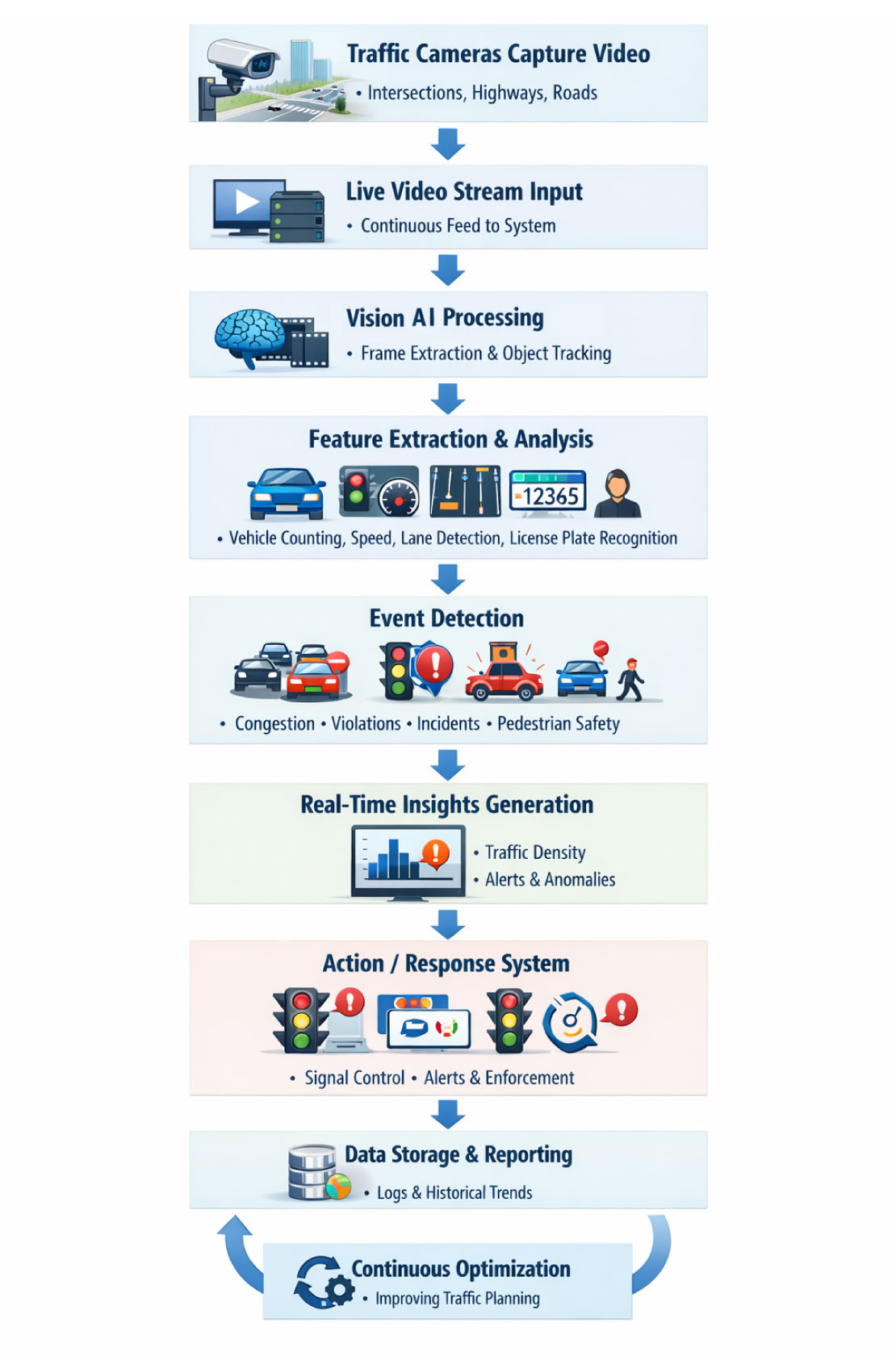
AI video analytics for traffic monitoring enables continuous interpretation of live video streams, transforming visual data into structured insights.
Traffic cameras capture activity across distributed road networks. Computer Vision models analyze this data to detect movement patterns, behavioral changes, and traffic conditions across locations.
This approach reduces dependency on manual monitoring and enables real-time visibility into road activity. Congestion buildup, violations, and anomalies can be identified as they develop, allowing traffic teams to respond faster and more effectively.
By converting video into actionable data, AI video analytics enhances situational awareness and supports data-driven traffic management.
Core Capabilities of Computer Vision in Traffic Monitoring and Surveillance
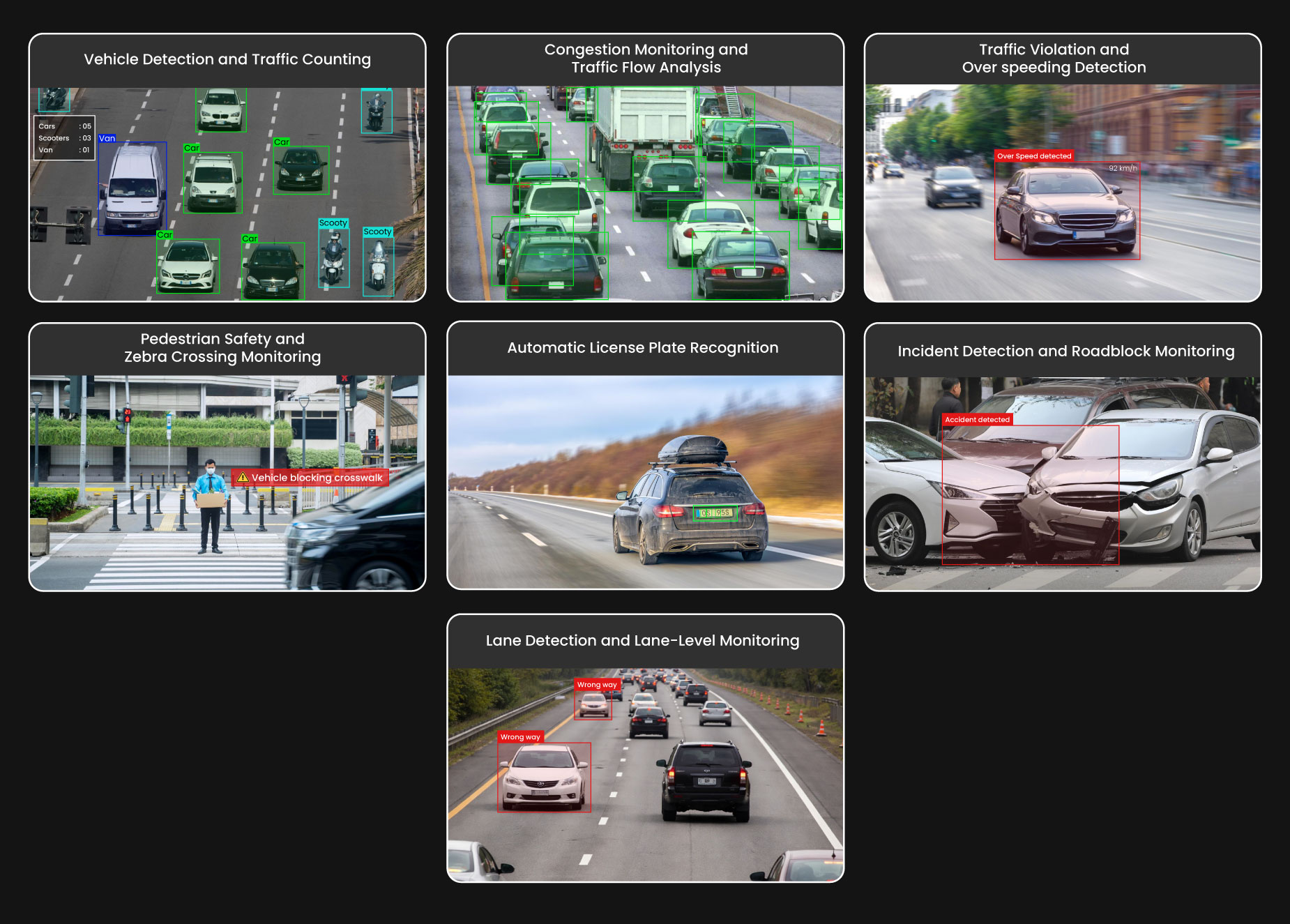
Computer Vision supports traffic monitoring and surveillance through capabilities that enable continuous insight and operational control.
Vehicle Detection and Traffic Counting:
Vehicle detection using Computer Vision identifies and tracks vehicles across road networks, enabling accurate traffic volume measurement and improved signal optimization. Vehicle Counting with Vision AI provides precise insights into vehicle flow across intersections and highways, supporting better traffic planning and infrastructure utilization.
Congestion Monitoring and Traffic Flow Analysis:
By analyzing vehicle density, speed, and spacing, systems can detect congestion early and support corrective actions such as signal adjustments and rerouting.
Traffic Violation and Over Speeding Detection:
Traffic monitoring solutions using Computer Vision identify violations such as over speeding, red-light crossing, and illegal turns by analyzing vehicle behavior, enabling consistent enforcement.
Pedestrian Safety and Zebra Crossing Monitoring:
Computer Vision systems monitor pedestrian crossings to detect obstructions and violations, improving safety in high-footfall areas.
Automatic License Plate Recognition:
Automatic license plate recognition with Vision AI extracts vehicle registration details from video feeds, enabling vehicle tracking and cross-location identification.
Incident Detection and Roadblock Monitoring:
Traffic monitoring systems detect accidents, stalled vehicles, and unexpected stoppages as they occur, enabling faster response and minimizing disruption.
Lane Detection and Lane-Level Monitoring:
Vehicle lane detection ensures adherence to lane discipline and helps identify violations such as unauthorized entry and wrong-way driving.
These capabilities enable scalable traffic monitoring and surveillance across urban environments and support real-time traffic management.
From Monitoring to Intelligent Traffic Management
The effectiveness of traffic monitoring depends on how quickly insights can be translated into action. With real-time traffic monitoring systems, operations move beyond observation to active management. Vision AI-powered traffic monitoring solutions enable:
- Faster incident detection and response
- Automated violation detection and enforcement
- Continuous traffic flow analysis for signal optimization
- Vehicle tracking across multiple locations
- Early identification of disruptions for proactive management
This transition allows traffic systems to operate more efficiently, with improved consistency and scalability.
Operational Impact on Traffic Management Systems
The integration of Computer Vision in traffic monitoring systems transforms how traffic operations are managed.
Monitoring shifts from periodic observation to continuous system-driven analysis, improving coverage across distributed networks without increasing operational overhead.
Response times improve as traffic events are detected in real time, enabling immediate corrective actions such as rerouting and signal adjustments.
Operational consistency also improves, as detection and analysis follow defined system logic rather than manual interpretation.
Over time, structured data generated from traffic monitoring and surveillance supports better planning, infrastructure optimization, and policy decisions.
Conclusion
Traffic monitoring is no longer limited to capturing video data. Its effectiveness depends on the ability to interpret and act on that data as conditions evolve.
Traffic monitoring and surveillance using Computer Vision, combined with AI video analytics for traffic monitoring, enables continuous analysis of road activity and supports timely, informed decision-making.
With capabilities such as vehicle detection, congestion monitoring, violation detection, and incident identification operating within a unified system, traffic management becomes more responsive, efficient, and scalable.
As urban traffic networks continue to grow, adopting intelligent, real-time traffic monitoring systems is essential for maintaining safe and efficient transportation infrastructure.
Get in touch to see how we can help optimize your traffic monitoring systems.