

Accelerating Retail Analytics with Planogram Compliance using Computer Vision
- Vathslya Yedidi
- February 6, 2026
Generate a quick summary


Retail shelf execution is one of the largest gaps between merchandising strategy and in-store reality. Planograms define how products should be placed to drive visibility, availability, and conversion, but maintaining compliance across large store networks is difficult to sustain.
In live store environments, shelf conditions change constantly. Customer interaction, replenishment cycles, limited staff coverage, and frequent promotional resets cause products to shift, gaps to form, and layouts to drift away from the planogram.
The impact is immediate and measurable. Misplaced products, missing SKUs, and prolonged out-of-stock situations directly reduce sales and degrade the shopper experience.
Planogram compliance powered by Computer Vision enables continuous shelf verification using images from cameras and mobile devices, allowing retailers to detect deviations early and correct issues before performance is affected.
Commercial Impact of Planogram Non-Compliance
Planogram non-compliance creates measurable financial consequences across retail operations. When shelf layouts drift away from planned merchandising standards, retailers lose revenue through reduced product visibility, missed conversions, and delayed corrective action. Over time, these execution gaps also increase operational costs by creating inconsistent inventory signals and avoidable store workload.
Execution Gaps in Planogram Implementation
Planograms serve as operational blueprints that translate category strategy into shelf-level execution. They define product placement, facings, adjacencies, and promotional positioning intended to improve shopping flow and sales performance. However, in live retail environments, these layouts are disrupted continuously due to replenishment activity, customer handling, staffing constraints, and frequent promotional resets.
Out-of-stock conditions remain a recurring challenge across grocery, convenience, and mass retail formats. When a shopper cannot find the intended item, the purchase outcome shifts quickly. Many substitutes with competing products, switch brands, or leave without buying, creating both immediate revenue loss and long-term loyalty risk.
Beyond lost sales, planogram deviations also create broader inconsistencies across the store network. These include incorrect shelf labeling, mismatched pricing, wasted promotional execution, and reduced trust in category performance reporting. Stronger shelf execution discipline has been linked to measurable improvements in category performance and operational efficiency.
Limitations of Manual Planogram Verification
Traditional planogram audits provide only point-in-time visibility in a fast-changing store environment. Monthly or quarterly checks cannot capture daily shelf movement caused by restocking cycles, shopper interaction, and assortment changes. As a result, many issues are identified after they have already impacted sales.
Manual verification also does not scale efficiently across large retail networks. Store teams and field auditors cannot realistically validate every aisle, SKU, and promotion at high frequency. Without continuous monitoring, execution becomes reactive, and compliance improvement depends heavily on labor availability rather than data-driven prioritization.
Computer Vision for Planogram Compliance
Planogram compliance using Computer Vision replaces periodic audits with continuous shelf validation. Shelf images captured from cameras, mobile devices are analyzed using Deep Learning models to compare shelf reality against approved planograms.
Instead of detecting shelf execution issues after the commercial impact has already occurred, this approach identifies deviations closer to when they happen, enabling faster correction cycles and more consistent merchandising execution across locations.
Planogram Compliance Verification System using Vision AI
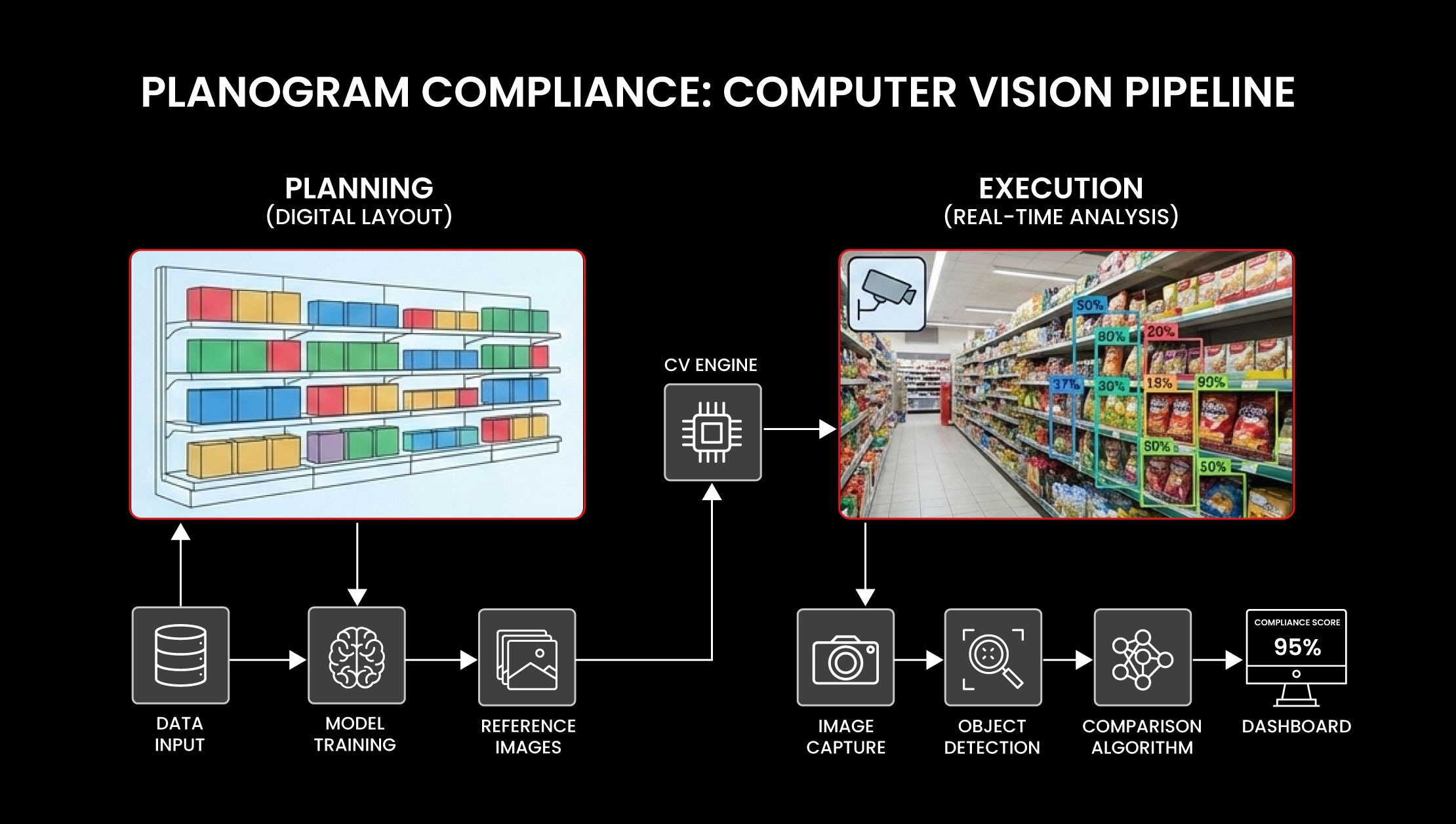
Computer vision-based planogram verification operates through a multi-stage technical pipeline. Each component supports a specific stage of shelf analysis, from image capture to compliance scoring.
- Image Preprocessing for Planogram Analysis
Shelf images are normalized using techniques such as de-noising and unblur. This improves performance across varied lighting conditions and challenging zones such as freezer aisles, end caps, and promotional displays.
- Object Detection and SKU Classification
Deep Learning models trained on retail product datasets identify products, packaging variations, and shelf labels. Detected items are matched against SKU master data and planogram references to establish shelf context. SKU recognition accuracy improves when models combine packaging appearance, shape cues, and text extraction.
- Planogram Compliance Verification
Spatial mapping correlates detected products with planogram coordinates to validate placement. The system measures facing counts, checks product positioning, and flags empty shelf slots where specific SKUs are expected.
It detects execution issues such as:
- misplaced products in incorrect shelf positions
- missing items in designated locations
- facing count mismatches
- promotional placement deviations
Compliance scoring can be generated at SKU, aisle, category, and store levels, enabling structured tracking across the retail network.
- Statistical Compliance Models
Machine Learning models establish baseline execution patterns by planogram section. This helps distinguish between recurring compliance breakdowns requiring process changes and isolated placement errors that can be corrected through routine shelf maintenance.
- Out-of-Stock Detection within Planogram Framework
Gap analysis identifies shelf spaces where planogram specifications indicate products should be present. Detection mechanisms can differentiate between temporary replenishment gaps and true stockout conditions requiring intervention, reducing false positives and improving response prioritization.
- Price and Label Compliance Verification
Optical character recognition validates shelf labels against planogram requirements and centralized pricing systems. OCR models extract pricing values, promotional text, and product identifiers from shelf tags. The system flags missing, outdated, or incorrect labels that can impact shopper trust and pricing compliance.
- Real-Time Planogram Compliance Dashboards
Cloud-based processing aggregates compliance data across locations, enabling enterprise-wide visibility into execution performance. Dashboards provide role-based views for store teams, operations leaders, and regional managers.
Alerting systems can prioritize deviations based on business impact, directing store personnel to high-priority issues such as missing high-velocity SKUs or incorrect promotional placement.
- Continuous Learning for Planogram Accuracy
Models improve over time using continuous learning mechanisms. The system adapts to new planogram versions, packaging updates, and store layout changes without requiring complete retraining, supporting long-term accuracy in real-world retail environments.
Planogram Compliance Detection in Action
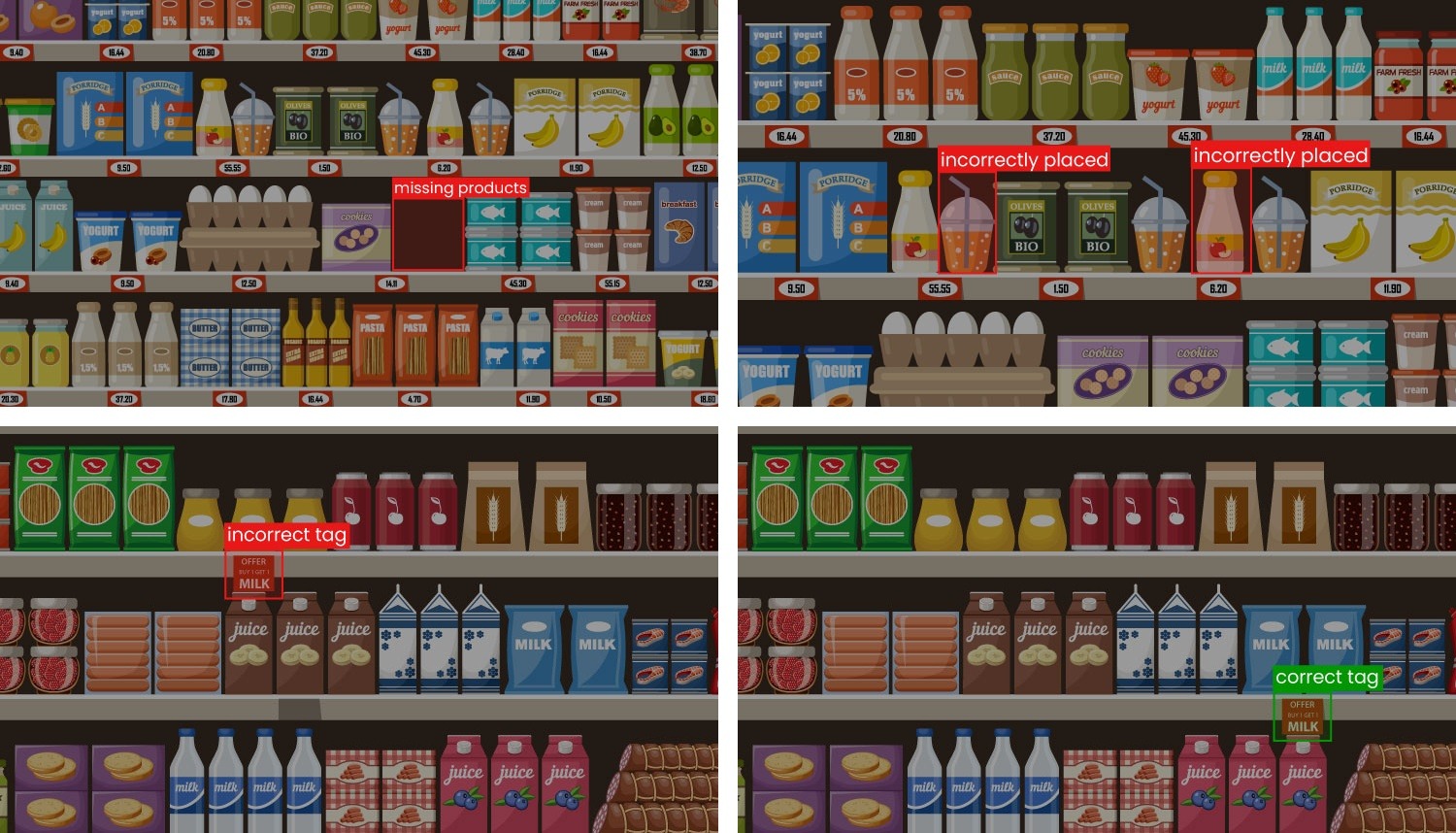
Computer Vision validates shelf execution by identifying deviations from approved planograms, including:
- products stocked in incorrect locations
- empty shelf positions where SKUs should appear
- facing count deviations
- non-compliant promotional displays
Automated visual verification accelerates issue resolution and reduces dependence on manual interpretation.
Deployment Models for Planogram Compliance Monitoring
Retailers deploy planogram compliance monitoring using multiple models depending on store format and planogram complexity.
Shelf-edge camera systems provide continuous monitoring for high-impact categories and promotional areas. Mobile audit workflows allow store associates to capture shelf images during routine walks for verification. Autonomous robotic systems can scan aisles during off-peak hours to deliver consistent shelf monitoring coverage across store networks.
Many retailers adopt hybrid deployment strategies to balance monitoring depth, operational effort, and scalability.
Implementation Considerations for Retail Planogram Compliance
While Computer Vision-based planogram compliance delivers measurable value, success depends on implementation readiness. Retailers should evaluate:
- Image capture consistency across lighting conditions and store formats
- SKU dataset quality and packaging variation handling
- Frequency of planogram changes and version control
- Integration with store task management systems for corrective execution
- Thresholds for alert prioritization to avoid notification fatigue
Starting with high-impact categories and scaling through phased rollouts typically produces faster adoption and clearer ROI.
Measuring ROI from Planogram Compliance Technology
Computer vision-based planogram compliance delivers measurable financial value across both revenue and cost dimensions. By improving shelf execution consistency, retailers reduce revenue leakage caused by missing items, incorrect placement, and pricing or promotional errors while also lowering the operational burden of manual audits.
Shelf execution accuracy directly impacts store performance. Better placement and stronger on-shelf availability improve shopper conversion, reduce substitution-driven losses, and increase the effectiveness of category strategy at the shelf level. Retailers implementing automated compliance verification also report higher compliance accuracy and faster issue resolution, particularly in high-velocity categories where execution gaps translate into immediate sales impact.
ROI is typically achieved through a combination of:
- increased sales from improved shelf availability and correct placement
- reduced labor costs by minimizing repetitive audit work
- fewer pricing and label discrepancies that affect compliance and shopper trust
- better promotional execution with less display leakage and waste
Retailers commonly validate impact through structured pilots focused on priority aisles before scaling across additional categories and store locations.
Operational Value from Planogram Compliance
- Inventory Optimization
Automated shelf verification improves the connection between shelf reality and inventory signals. By identifying missing items, shelf gaps, and recurring execution issues early, retailers can reduce time-to-correction and maintain shelf layouts aligned with merchandising intent.
- Labor Productivity
Computer Vision reduces the need for repetitive, manual compliance checks. Store teams spend less time inspecting shelves and more time correcting targeted issues flagged through analytics, improving task efficiency and execution speed.
- Merchandising Effectiveness
Consistent shelf execution ensures category strategies deliver intended results across locations. Compliance scoring provides structured visibility into performance, enabling retailers to measure how execution quality influences sales outcomes. This also supports continuous refinement of planograms based on what works in real store conditions, not just in theory.
- Customer Experience Enhancement
Shoppers benefit from organized shelves, accurate labels, and better product availability. When shelf layouts match merchandising intent, product discovery becomes easier, purchase friction decreases, and customer trust improves.
Conclusion
Planogram compliance using Computer Vision enables a scalable operating model for validating shelf execution against merchandising specifications. By converting shelf images into insights, retailers gain faster visibility into execution gaps, more consistent shelf standards, and measurable commercial improvement through stronger on-shelf availability and merchandising accuracy.
As retail margins tighten and planogram complexity increases, automated shelf compliance monitoring is becoming an operational requirement rather than an optional capability.
To evaluate business impact, retailers can start with a focused pilot in high-priority categories to measure improvements in shelf execution, availability, and correction speed before scaling across store networks.